The Moonshot Podcast: Neurons and Networks

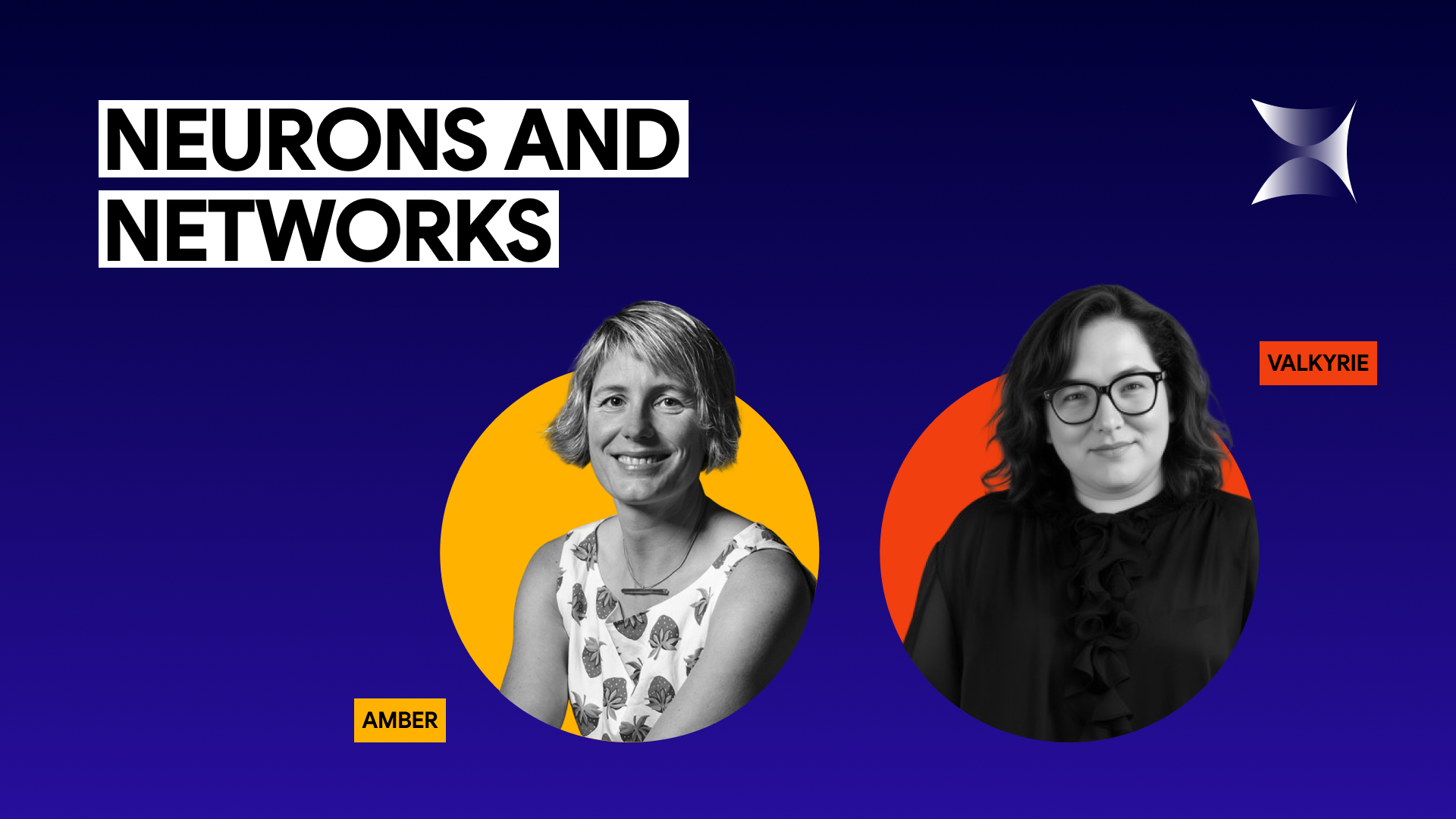
This episode of The Moonshot Podcast explores what the mind can teach us about technology—and what technology can teach us about the mind.

I recently went back to X, The Moonshot Factory to talk with my former boss and friend Astro Teller about Project Amber, the mental health measurement project I ran at X before I left to start Flourish Labs.

Amber was a team of neuroscientists, hardware engineers and ML people who designed an EEG device that could detect and measure mental health conditions like anxiety and depression. I like to think of Project Amber as my first mental health startup…. I learnt so much about the business of mental health that was invaluable for Flourish Labs.

The podcast also spotlights Valkyrie, a never-before-shared X project that explored new ways to build energy-efficient AI models by studying the formation of biological brains – led by Sarah Laszlo, PhD who was also one of the cofounders of Project Amber.

Watch the full podcast on YouTube:

Or listen to it on Apple Podcasts, Spotify, YouTube Music, or wherever you listen to your podcasts.

https://x.company/moonshotpodcast/


In this podcast, Astro explores what the mind can teach us about technology—and what technology can teach us about the mind. He first sits down with Sarah Laszlo from Valkyrie, a never-before-shared project that explored new ways to build energy-efficient AI models by studying the formation of biological brains like the fruit fly’s. He then chats with Obi Felten from Project Amber, a mental health moonshot that aimed to design an affordable EEG device that could detect and measure conditions like anxiety and depression.

0:00 – Intro
01:19 – Inside Project Valkyrie with Sarah Laszlo
03:30 – Mapping a fruit fly’s brain in 3D
05:21 – Project Valkyrie’s moonshot
06:44 – How biological brains could inspire foundation models
09:25 – The Valkyrie team’s first explorations
11:20 – Translating a fruit fly’s brain into a flying model for Wing
14:11 – Reservoir Computing explained simply
15:47 – From insect brains to agriculture
17:36 – Why Valkyrie hit a roadblock
20:37 – How Sarah wound down Valkyrie
22:32 – Up close with a 3D-printed fruit fly neuron
24:40 – Bringing “unbridled joy” to moonshot-taking
27:58 – Inside Project Amber with Obi Felten
29:10 – Why mental health needs a moonshot
32:11 – The “What-If”: Can you actually measure depression?
34:49 – The challenges of mental health measurement
36:17 – Other Amber explorations
39:39 – A look at Amber’s original prototypes
46:50 – The “Kill Criteria.” Knowing when to walk away
50:33 – Sharing Amber’s findings with the world
52:56 – Flourish Labs: Obi’s next chapter
54:45 – Obi’s early memories from X
57:44 – Final thoughts
Inspiring Women Podcast #186

Can a million peer supporters transform mental health care for 35 million Americans?

Obi Felten, CEO and founder of Flourish Labs, believes it’s possible. In this eye-opening episode of Inspiring Women, host Laurie McGraw delves into Felten’s groundbreaking approach to solving the mental health crisis for youth.

Felten, a former Google X executive, shares her journey from developing moonshot technologies to tackling one of healthcare’s most pressing challenges. Learn how Flourish Labs is revolutionizing mental health support by training young adults with lived experiences to become peer supporters, creating a more diverse and relatable workforce.

Key takeaways:

 The staggering gap in mental health care: 20 million teens and young adults with mental health issues, but only half receive care

 How Flourish Labs is breaking barriers by securing contracts with Medicaid plans

 The power of peer support in addressing critical issues like post-ER care for suicidal youth

 Felten’s vision for scaling peer support to help millions of underserved individuals

Discover how Felten’s unique blend of tech innovation, healthcare expertise, and peer support culture is reshaping the future of mental health care. This episode is a must- listen for anyone interested in mental health, healthcare innovation, or inspiring entrepreneurial journeys. 

Watch the recording here:

Business Insider: Inside a secret haven for startup founders to overcome loneliness: ‘There’s very few people you can be honest with’

By Darius Rafieyan

This article was published on Nov 2,2023
Copyright Business Insider 2023
Read the original on BusinessInsider.com (subscription required)

  • Leaders In Tech is a four-day, invite-only retreat for tech founders and CEOs held in Northern California. 
  • The retreat is the brainchild of author and executive coach Carole Robin, and is based on the Interpersonal Dynamics course she taught at Stanford Business School. 
  • The retreat, which costs about $10,000, is meant to help participants open up and cope with the loneliness of helming a prominent tech company.
Obi Felten, founder of Flourish Labs
Startup founder Obi Felten said she struggled to find spaces where she could let her humanity show.
Photo: Justin Kaneps

On a recent weekend, at a seaside resort outside San Francisco that once served as a pleasure palace for a turn-of-the-century radio mogul and later became the home of a sinister, new age cult, twelve perfect strangers sat in a circle overlooking Tomales Bay.  

As the sun glinted on the water and a breeze off the wetlands shook needles loose from the pines overhead, Joe—founder and CEO of a fintech startup most recently valued at $45 million, who opted not to use his real name for this story because of the personal nature of what he was speaking about—recounted the day last year that his father died. He had been devastated, but didn’t feel like he could take a day off. His company was in the middle of raising a funding round and he just couldn’t let his team down. There was no time for grief in his busy schedule.

Joe knew next to nothing about the people he was confiding in, not how many exits they’d had, nor who their investors were. He didn’t even know their last names. But he knew they were all founders and that they understood, and so he did something he hadn’t allowed himself to do in a very long time: he cried. 

“Once the words came out, I was emotionally exhausted, but I was also relieved,” Joe said. 

This was day one of Leaders In Tech, a four-day, invite-only retreat for startup founders like Joe, designed to help them open up, process trauma, and learn to cope with the loneliness that comes with helming a prominent tech company.

The program is the brainchild of Carole Robin, an author and executive coach who for more than 20 years taught the Interpersonal Dynamics course at Stanford Business School. 

Carole Robin, co-founder of Leaders in Tech
Author and executive coach Carole Robin, speaking at a Leaders In Tech retreat. 

She says that founders are expected to be relentless optimists, and impervious to doubt. Whether it’s their investors, their employees, or even their spouses, the pressure is always to tell a story that goes up and to the right. 

“They don’t have anybody they can be real with,” Robin told Insider, “so they’re always having to spin their image, and spin what they say, and spin how they’re seen, which adds to the loneliness and the sense of isolation and also frankly, mental illness.”

A mental health crisis for founders

The data on founder mental health is spotty (most don’t like to advertise their struggles) but a 2015 survey of entrepreneurs from UC Berkeley found that 72% reported mental health concerns (for comparison only about 20% of the general population suffers from mental illness). Entrepreneurs in the survey were significantly more likely to report suffering from depression, bipolar disorder, anxiety, and substance abuse disorders.

These challenges have always been a fixture of the founder’s life and something of an open secret in Silicon Valley, but they’ve only been exacerbated by the recent market turmoil.

Some founders deal with the pressure by microdosing ketamine, or doing 48-hour fasts, or riding double-decker bicycles through the desert at Burning Man. But for many, even admitting that they’re struggling can feel impossible. 

“You run into people at conferences and you talk about how everything’s great,” said Obi Felten, a former Google executive and founder of mental health startup Flourish Labs who attended a retreat last month. “You go through this whole bullshit, but there are very few people that you’re truly honest with,” she said.

With Leaders in Tech, Robin set out to create a space for founders to practice vulnerability, free of the need to always be crushing it. 

Lodge at Marconi
The Leaders In Tech Retreat provides a world away from the relentless stress of Silicon Valley. 

It’s open to founders and CEOs who have raised at least a Series A but are pre-IPO, who for about $10,000 can spend four days in a charming bungalow on the grounds of the Lodge at Marconi resort in Marshall, California. Days are spent in intensive emotional labor with nights devoted to communal dinners and gatherings around the fireplace.

‘If you really knew me’

Participants meet in groups of 12, carefully selected to ensure no one is paired with a competitor or potential investor. Pitches, resume rundowns, or anything that smacks of networking is strictly forbidden.

“They’re being real. Nobody’s trying to sell anybody anything, nobody’s trying to raise money from anybody else,” Robin said. 

They spend up to twelve hours a day in intensive “T groups” (Robin is quick to say the T stands for training, not therapy) where facilitators lead exercises designed to break down barriers and foster authentic connections. 

For example there’s something she calls “If You Really Knew Me”—an exercise where founders talk about themselves for two minutes, beginning with the phrase “if you really knew me…” 

Some responses from founders Robin remembers from past sessions:

“If you really knew me, you’d know that I feel like I have to put on a suit of armor every single morning when I leave the house.”

“If you really knew me, you would know that I’m, I’m worried about whether or not my marriage is going to survive my startup.”

“If you really knew me, you’d know that I will not sit here for four days and listen to everybody talk about how they’re crushing it.” 

For Felten the retreat provided a welcome antidote to the transactional artificiality of networking events. 

“In the first session we all exposed and disclosed stuff about ourselves that probably even some of our best friends or our partners might not know,” she said. 

During her retreat Felten focused on anger, an emotion that as a female CEO she felt she was never allowed to express. On the second day in her T group, as she was opening up about her family’s struggle with addiction and mental illness, she exploded at one of the other participants. 

“And I remember in the moment thinking, oh my god, I’m doing the thing that’s not okay to do, I’m getting angry,” she said. But rather than shut down her raw emotions, the other members of her group helped her process that anger and see that it was really just an expression of fear. 

“Unpacking it in that safe environment was a massive breakthrough,” she said. 

That evening after dinner, Felten went for a swim in the icy waters of Tomales Bay. She said the cold plunge felt like a much-needed reset after the hours of grueling emotional work. Floating out there in the Pacific, she was only two hours from Menlo Park but somehow a million miles from Silicon Valley.

Felten’s first day back at work after the retreat was rough. Her husband was out of town and the day started in a fight with her daughter that made her late for the Monday meeting. Feeling the anger bubbling up again and remembering what she learned in her T group, she decided to open the meeting with her colleagues by talking about what a hard time she was having. Others jumped in, commiserating about frustrating boyfriends and intractable children. Multiple employees later thanked her for creating the space to show weakness.

For Joe, the fintech founder, the plan had been to return to work Monday morning after the retreat. Instead just a few days after he broke down talking about his father, he did another thing that he hadn’t allowed himself to do in years: he took a day off for himself.

“Normally I would just dive back in,” Joe said, “but I remembered something someone in my T group said, they said, “you’re always taking care of everyone else, who’s taking care of you?”

Freakonomics Radio: Steve Levitt’s “People I mostly Admire”

Freakonomics co-author Steve Levitt and I had a great conversation on his “People I (Mostly) Admire” podcast, on everything from dream jobs and fantastic failures, to the power of mental health peer support and the fall of the Berlin Wall. These are topics close to Steve’s heart, so I also learnt quite a bit about him—including some surprising personal parallels, which I wrote about in this blog post.

Obi Felten used to launch projects for X, Google’s innovation lab, but she’s now tackling mental health. She explains why Steve’s dream job was soul-destroying for her, and how peer support could transform the therapeutic industry.

You can listen to the podcast on the Freakonomics website here, or download the episode on Apple Podcasts, YouTube Music, Spotify, Stitcher, or wherever you get your podcasts.

Episode Transcript

My guest today, Obi Felten, was in charge of moonshots at Google’s Innovation lab, what’s called X or formally Google X. X has had both big successes like Waymo, one of the first self-driving vehicles, and high-profile failures, like the attempt to provide global Internet using a network of stratospheric balloons.

FELTEN: The pressure of producing the next self-driving car and the next balloon project was absolutely immense, like it couldn’t just be any old thing. It had to be something really incredibly amazing that was also very undefined.

Welcome to People I (Mostly) Admire, with Steve Levitt.

As if moonshots weren’t enough to talk about, Obi’s, now heading a startup called Flourish Labs. She’s trying to transform the way mental health services are provided to young people. And the whole time I’ve been living in Germany I’ve been trying to find a German guest for this show. Finally with Obi, I’ve got one. She grew up in Berlin and she watched the Berlin Wall come down as a teen. That’s one more topic I have to be sure to cover.


LEVITT: When you worked at Google’s Innovation Lab, you had a very unusual title, right?

FELTEN: My title was Head of Getting Moonshots Ready for Contact With the Real World. Everyone thought it was a joke. And it came about when I sat down with Astro Teller who hired me into X and he was running a bunch of projects at X at the time and then later on took over the whole group. He had hired me somewhat on a whim as one of the first non-engineering people in the group. We had this great conversation where he told me about these projects that were all secret at the time, even inside Google. I was working for Google in Europe at the time. So it was basically a group of engineers who were working on self-driving cars and Google Glass and a drone project and an internet from balloons project and so on. And then I asked him a bunch of questions like, is it legal to fly balloons over countries? Do you have to talk to countries to get their permission to fly over? How is this going to bring internet to everyone? Are you going to partner with phone companies or compete with them? And he looked at me and he said, “Those are really good questions, but no one in the team is really working on those. Why don’t you come and help us with those?” And that’s what I did. I looked at everything from policy and legal matters to how might we talk about some of these projects, how do we take them to market, do we have a business plan for any of them? It turned out they didn’t really, at the time. So the title was very descriptive of what I was doing, which was thinking about what would happen when this technology would grow up and get out of the lab and make contact with the real world.

LEVITT: If I let my imagination run wild and I try to think of my dream job, the exact job I’d think of is the one you just described. Being around amazing engineers doing incredible technologies and trying to figure out how to get them to work. I can’t believe you actually got to do that.

FELTEN: I did get to do that. It was mostly really fun. The engineers were amazing. We then hired a whole bunch more non-engineers. You know, we got real lawyers, and we got real policy people, and real marketing people, and so on. So it wasn’t just me making it up.

LEVITT: Did that make it more fun or less fun when there were real people around?

FELTEN: Ah, that’s a really interesting question. Sometimes I wonder whether it takes the magic out of it, because while you’re just working on the technology and you’re imagining what the world would look like when you succeed and you solve these big problems in the world with the tech, it’s much more fun and magical. And then the reality hits that it’s sometimes very small things that make it hard to implement something in the real world. On the other hand, if the tech doesn’t get out into the world, what is the point? I mean, I’ve always felt that technology is just a tool. And unless we solve problems with it that people actually care about, it’s pointless.

LEVITT: So for listeners who don’t spend their days working at X, or what used to be called Google X, like you did, what is X? How does it fit into Google and what’s it trying to do?

FELTEN: X is an unusual innovation lab because most corporate innovation labs were set up to move the core mission of the company forward. So if you think of the sort of mother of all innovation labs, Bell Labs, they were solving problems for the mother company. And X was actually explicitly set up with a remit to not solve core Google problems because there was already innovation going across the entire business. The founding project was self-driving cars and that’s not really anything to do with search or advertising or any of the other Google products. So they set it up quite separately, and they gave it a small budget and a lot of freedom. Initially it was all just about building interesting breakthrough technology. We started with that tech piece, but then we realized very quickly, if it doesn’t solve a real problem, it’s also kind of pointless. I think we learned that the hard way with Google Glass, where it was really amazing technology, but it didn’t solve anyone’s real problem, and therefore it failed. And so in the end, we came up with this definition of a moonshot, which is: we take a problem that would affect hundreds of millions, maybe even billions of people in the world, and then we propose a radical solution that sounds very different. It maybe sounds like science fiction today, but within maybe five years, the technology can turn that science fiction into reality. And self-driving cars is a really good example of that, where for most of the 20th century that was total science fiction. And yet, in the last 20 years, sensors are much better, compute power has multiplied, so you can take all that sensor data in and turn it into an action that the car can take. That just was completely inconceivable and yet it’s now reality.

LEVITT: So let’s talk more about driverless vehicles because I think at some level, it’s a huge success for Google X. But at another level, I’m surprised by how slow the progress has been, not on the technology side, but on getting the autonomous vehicles on the road at scale, and how much public resistance there’s been to the vehicles. Has that surprised you also?

FELTEN: That path was definitely a long one, but I think for good reasons, because this is a pretty radical technology. It’s still a little spooky when you see the car go by and there’s no one in the driving seat. It takes time for people to get used to it, to get over their fears of the technology, and frankly, for the makers of the technology to be cognizant of how it affects society and how it might fit in. If we just put a really half-baked prototype of a piece of software out into the world, usually people don’t get harmed, but if you put out a robot car into the world, you have to be really conscious that it’s safe enough.

LEVITT: I’m surprised how measured and calm you are to describe this because I’m not even involved in it. And I think about it like an economist, and I think 40,000 people a year die on the roads in the U.S., and worldwide, I think the number’s over a million people a year are dying on the roads. And virtually every one of those deaths is because of human error.

FELTEN: Over 90 percent of accidents are due to human error. It’s hardly ever the machine that fails.

LEVITT: And I suspect that already the autonomous vehicles are way, way better than humans in all but maybe the most extreme cases. And humans make mistakes constantly behind the wheel. But still, if an autonomous vehicle makes a mistake — it doesn’t even have to be a fatal mistake — if they simply snarl traffic, it becomes headlines. And I would think that would just get you angry because you’ve sunk your blood, sweat, and tears into this and you have a great solution.

FELTEN: I mean, there’s the lifesaving aspect, which I definitely believe that’s true because human drivers cause most of the accidents. That was the reason why Mothers Against Drunk Driving were one of our early advocates, actually, in those very early days when there was a lot of resistance against self-driving cars. The other aspect is parking. If you could make taking a robot taxi cheap enough, then you wouldn’t need your own car. And most cars just sit around all day long, either on the street or in a parking lot or in a garage, and it’s just completely wasted space in our cities. So there’s definitely benefits to self-driving cars, but I think the fear runs very deep and there’s also a lot of entrenched interests, right? Self-driving cars is probably one of the few technologies where people expect that the A.I. will entirely replace the whole job. And, you know, driving is a good job. It’s often like the first job that someone does when they come to a country or long distance truck driving is a very middle class job that supports families, et cetera. So I think there’s a lot of resistance from that point of view as well that you can’t underestimate.

LEVITT: Yeah, I think 2 to 3 percent of the entire workforce is employed driving. And that’s going to be a big displacement when it happens.

LEVITT: The Google X project that got you to move halfway across the world from London to Silicon Valley was Project Loon, right?

FELTEN: Yeah, that’s right.

LEVITT: Could you explain the idea behind Loon?

FELTEN: Yeah, absolutely. So at the time, I was working for Google in Europe, Middle East, and Africa, and I was actually running consumer marketing. So launching products like Chrome and Android and many that failed that you’ve not heard of. And I saw firsthand the impact that the internet was having on countries when they were first coming online. And Project Loon, the idea was that you would connect the whole world with a network of stratospheric balloons. So these are balloons that are flying literally on the edge of space. So they’re way above air traffic. Cell towers on the ground, the economics are very much tied to how many people you can serve at that tower. So if you’re in a city, it’s very profitable. If you put it in the middle of nowhere, it’s very unprofitable. And that’s the reason why, when we started Project Loon, two thirds of the world — and by that I mean people — had no access to the internet yet. And so the idea was, what if you put that cell tower onto a balloon and you send that balloon across the whole world? So it was beautiful, it was elegant, the tech sounded really cool. Who doesn’t love balloons, frankly? And one of the first things I did was write the business plan with the team and try to work out how we would actually take this out into the world, because in almost every country, the phone company is an incumbent that’s very close to the government. And so there was a real danger that if the project leaked and we couldn’t make a proper announcement and we couldn’t reach out to partners early enough, that the phone company would just go to the government and say, “Those balloons that they want to send over our country, just say no, you know, don’t let them travel into our airspace.” And we eventually found a country that was super friendly. It was New Zealand who were very forward-looking when it came to internet access because they have actually a very big, rural area where there’s more sheep than people. And so we announced the project in New Zealand and the Prime Minister actually came to the launch.

LEVITT: You all worked on Loon for a long time, but it folded, right?

FELTEN: Yeah, that’s right. The economics didn’t work. So that beautiful business case that we wrote early on relied on the balloons becoming cheaper and cheaper with scale, and that never really materialized. And then in the meantime, the cost of cell towers did come down. That’s a hard place to be, right? If you’re competing with the incumbent solution that you don’t have to convince anyone to use as an alternative becoming cheaper and cheaper, and your new kind of radical solution isn’t getting cheap enough, then it’s difficult to compete.

LEVITT: I’d love to step back and talk about the process at X. I think many people have this idea in their head that there’s this wild haired genius who dreams up solutions whole-cloth, like the supposed story of the apple falling on Newton’s head, but that’s not at all my experience in the real world. So could we just start at the very beginning? Who generates the ideas at X? Is that the job of a small group of people or something everybody’s part of?

FELTEN: So the beginning of the process in X was actually very messy and almost deliberately chaotic. So there’s a team called Rapid Evaluation and the idea was to rapidly evaluate lots and lots of ideas and find out as fast as possible which ones weren’t going to work. So I’d say over 90 percent of the ideas that the Rapid Eval team looked at got thrown out pretty quickly, sometimes within hours or days or weeks, but certainly within months.

LEVITT: Where did the list of ideas that Rapid Eval looked at — where were those ideas coming from?

FELTEN: Lots and lots of different places. That team was a team of polymaths. So lots of them had basic backgrounds, like physics, for instance, which meant they could understand lots of things in the world. They would go to conferences, they would read papers, people would send them inbound ideas, and so on. At X, many of the ideas actually came out of academia. So when you look at self-driving cars, for example, there was a long history of self-driving car experiments being done in universities that we could build on. And there’s a huge barrier often for academics to take something into the real world, especially if it’s not biotech for which there’s much more established pathways. I sometimes think of X as taking the baton off someone who comes up with this radical idea; from the question of “Can this work at all?” to “Yes, but how?”

LEVITT: Let’s say there are a hundred ideas that come from somewhere in Rapid Eval; how many of those hundred would make it past that first stage, the stage of a few hours or a few days of analysis?

FELTEN: Probably no more than 10.

LEVITT: Okay, so 90 percent are stillborn, essentially. So it’s 10 ideas survive and then what happens next?

FELTEN: The next stage is what we call Early Stage Projects. So in the external world, that might be, like, from seed funding to series A funding. And so in that Early Stage team, we would continue to do prototypes of the technology, but we would also start looking at things like, what is the best use case for this? What might be a business case behind it? How might we eventually find something resembling — I hesitate to call it product market fit because often it was too early, but at least technology problem space fit? So it’s a bit of a back and forth between figuring out what’s the right tech to solve a particular problem and what are the problems that a particular tech might be able to solve? And at that stage, it’s probably about 10 or 15 projects over about two years and only about half of those survived.

LEVITT: So about five out of the hundred ideas make it —

FELTEN: To stage three.

LEVITT: To stage three. Anybody who’s in the business of creativity needs to recognize that your ratio of five out of 100 — is not unusual. That’s probably a pretty good ratio of success. What you cannot ignore is that you need a huge number of ideas if you hope to have anything good come out the other side. At least in academics, the economists I was around didn’t understand that. They thought if they had a couple projects, that was good, that would be fine. But my own approach was to spend just an inordinate amount of time working on ideas. And my threshold for a good idea is a lot lower than X’s threshold for a good idea, but I still would only have two or three out of those hundred that would ever turn into anything interesting.

FELTEN: I guess it’s a difference in approach. Either you think you can perfect the one thing you’re working on, or you just iterate really quickly to find out what doesn’t work. I think that’s a helpful way of thinking about it. You’re not trying to fail fast — that’s another one of those Silicon Valley cliches. But the goal is to learn as quickly as possible if something doesn’t work. And it’s more about the speed of the innovation cycles. And also, how quickly can you evolve an idea? Because you might have started in one place and then ended up somewhere very different. That, I think, is the hardest. Like, when do you throw it out altogether? And when do you think, “Oh, this could just benefit from a pivot”?

LEVITT: Everything I know about human nature suggests that projects that are failing go on way too long. What were the specific strategies you used at X to fight that bias?

FELTEN: There’s definitely a huge bias towards just keeping going with something. Economists call it sunk cost fallacy. Physicists call it inertia, like to get an object to deviate from the path is just very difficult. There’s a few tricks that we use. There was one, actually, that one of my teams taught me. It was a project called Foghorn. And the idea was that we would make fuel from seawater. So you pull CO2 out of the sea, which acts as a huge carbon sink, and then you would combine it with renewable hydrogen to make it into a renewable fuel. And the cool thing about that fuel was that you could burn it in any engine. So you could burn it in a car with a tiny bit of retrofitting. You could also fuel airplanes with it. And at the same time, you would pull carbon out of the sea, which is actually good for the sea. So I love the idea. It was such a cool concept. So the team did a whole load of technical exploration, and they found that they could make the technology work. But they had set themselves two criteria. So they had technical criteria, but they also had a business goal, which was that they wanted the fuel to be the same price at the pump as fuel that was made from conventional oil. And as the oil price was collapsing, during the project, it became very clear that there was no way we could compete. And so they had essentially hit what they called their kill criterion. And they came to me and they said, “We should shut this project down.” At least at that time, there was no way that we could ever make the economics work. A lot of things would have to happen, like a much higher price on carbon and so on, until it was even vaguely viable. What was interesting about this is that the team had set their own criteria. And therefore the decision to shut the project down came from them, and it was a much more rational decision. As opposed to, an emotional decision.

LEVITT: I’ve heard that one of the strategies that X uses is to work on the hardest part of a problem first, because you don’t want to solve all the easy parts only to fall down five years into the project on the hard part.

FELTEN: Yeah, it’s a very counterintuitive strategy to start with the hard parts. So what we did at X is we had this image of a monkey on a pedestal. And the story was: Imagine you’re trying to train a monkey to recite Shakespeare sonnets while standing on a pedestal. What do you work on first, the monkey training or the pedestal? And it’s very tempting to build a pedestal first because we know how to build a pedestal. So we can make this beautiful pedestal. We’re very proud of ourselves. But then what if in the second year of the project, you find out it’s actually impossible to teach the monkey English, let alone recite Shakespeare. So then you’re left with this totally useless but very beautiful pedestal. And so we had this premise that we would always do monkey first. So we would identify what the hardest problems were and work on those. It’s hard because I don’t think most of the world thinks that way. So investors will constantly be like, “Oh, what progress have you made this month? So it’s very difficult to say, “Oh, I solved, like, a hundredth of this really hard problem.” That feels like no progress at all. And sometimes you’ve got these sort of jumps, where it’s not a linear, nicely incremental, “I make some progress every month,” but suddenly you have a breakthrough and then it suddenly works, right?

LEVITT: Another non-obvious thing that I’ve tried to do in my own projects is to celebrate the failures, to treat failures as successes because they free you up to go and pursue other things. Did you have strategies for doing that?

FELTEN: At X we tried various different things. So one is: get people to talk about it at all-hands meetings, because otherwise all-hands just becomes this sort of show of successes. If you talk about things that didn’t work, then you kind of attribute more value to that. That applies in academia, by the way, as well. I’m on the board of a big academic publisher. They publish Nature and lots of academic journals. And, of course, it’s much harder to publish a null result, right? No one ever wants to publish, like, here’s something that didn’t work, even though that would be very useful because it would stop lots and lots of other scientists trying to do the same experiment over and over again. But if you go back to X, that Foghorn team that came to me and said, “We want to shut down our own project,” they’d actually done a very detailed postmortem and they presented that at the all-hands. They then also published it as two academic papers so that people wouldn’t try the exact same approach that we had tried. And so making it public and talking about it takes some of the stigma out of it. The other piece is that you have to acknowledge that there’s some grief around it and that however rational you try and make the decision, there’s always going to be emotion. People lose their jobs, people have to give up on something that they’ve poured their life and blood and sweat and tears into. So it struck me when I was running this team where we were starting dozens of projects a year and shutting down dozens of projects, so I was going through these life death cycles over and over again — that there’s quite a lot of similarity between grief for a human and grief for a project. And I don’t want to belittle what you go through when a loved one dies. This is not to say your project shutting down is on the same level, but it’s a similar process. There’s a model called the seven stages of grief. And I saw the teams go through similar phases, like you’re in denial, you’re angry, and then eventually you get through to acceptance. And the faster you can get through those cycles, the better, actually. And if you don’t go through the cycles, it sort of lingers. It’s just pushed down. And so one of the things we did is we started celebrating the Day of the Dead. And before you accuse me of cultural appropriation, it was actually the idea of — two Latinas in my team came to me and said, “Obi, there’s all this trauma, all this stored up grief, all these projects that we’ve shut down, and we should be celebrating this. And so in the Mexican Day of the Dead tradition, you remember the dead. You remember all the things that are amazing about them and you think of them lovingly and then you let them go. So we started doing this as a ceremony, and it was incredibly cathartic; people cried. And I think if you neglect that emotional aspect, if you try and make it just rational, you’re kind of missing out on a really important part of what it means to let go of something.

LEVITT: That’s interesting. I’ve never tried to go into that emotional space on my projects. I’m going to try that the next time.

FELTEN: Yeah, try it. It’s very hard to let go if you don’t process the emotion.

We’ll be right back with more of my conversation with Obi Felten after this short break.


LEVITT: When I heard about your job at X, it sounded like a dream job to me. And then the way you’ve spoken about it so far, it seems like it was a dream job for you also. But you left a few years ago to do something else. How come?

FELTEN: So I’d say my job at X was a dream job, for sure for the first few years. But it was actually really soul destroying for me. It was this endless cycle of just launching projects, hiring people, and then having to fire them again when we shut the project down. And it took a toll not just on the teams, but also on me, which I now realize looking back. The pressure of producing the next self-driving car and the next balloon project was absolutely immense, like it couldn’t just be any old thing. It had to be something really incredibly amazing that was also very undefined. Whereas when I worked at marketing at Google, I had really clear metrics. Like we get 100 million Chrome users. That’s successful. If we get only a million, that’s not as successful. But at X everything was just a little fuzzier and less measurable. And then the final thing was a good friend and coach told me, “You are just in the wrong job for you because there’s some people who are scuba divers, they love to go deep, and there’s some people who are snorkelers, who love to go across a whole bunch of things. And you’re a scuba diver in a snorkeling job.” And what I realized was, yes, I was overseeing projects that were as diverse as, you know, we had a chip project for machine learning chip that later went to Google. We had two or three different sustainability projects, like the Foghorn project I talked about, which was all about chemistry. We had another one called Malta that was about storing energy in molten salt, that was all about physics. I had all this diversity in the portfolio, which meant I could never go deep on anything. And it wasn’t my job. It was the team’s job to go deep on them. So I suddenly realized, oh, this is a dream job for other people, but it’s not a dream job for me. I’ve been happiest when I’ve been building things. So I went to Astro, the head of X, and I said, “Look, I’m going to quit. I’m going to go back to the startup world.” And he said, “What? Like, why would you want to leave?” And I said, “Because I want to build something again. You know, I’m a builder at heart.” And so he said, “Why don’t you pick something that you’re really passionate about and build something in that area.” And the area I was really passionate about was mental health, for personal reasons. And so the project that I picked was called Amber. And I co-founded it with a neuroscientist and with a hardware engineer. And the idea is, could we find a biomarker for mental health? So it’s very difficult, still, to assess how depressed or anxious, for example, someone is. We looked at E.E.G. brainwaves and we looked at wearable data and other kinds of data that might give you a pointer that is more objective than just asking people how they’re doing, which is largely how, in today’s world, mental health is assessed.

LEVITT: And that’s working out well?

FELTEN: I ran the project at X for several years and we made great progress on the technical side. So it turns out that you can actually see in someone’s brain waves how depressed they are. The experiment is you make them play a little game and then you see what happens in the split second after they find out whether they lose or they win. In most people, there’s a sort of spike. But it turns out in many people with depression, they have something called anhedonia, where that spike is subdued. So you can see, by the length of the wave and the amplitude of the wave, you can see how depressed they are. And that’s kind of magical. It’s completely objective, like you can’t cheat. And we thought that would be really incredibly useful. And it turns out, when we did hundreds and hundreds of interviews with people with depression and anxiety, young people, postpartum mothers, and others — we interviewed psychologists, we interviewed psychiatrists — and they all said pretty much the same thing, which is, yes, we need better measurement of mental health, but it’s not the biggest problem. I will never forget one gynecologist who said to me, “I know some of the mothers I see have postpartum depression, but I’d rather not find out because there’s no one I can refer them to because there’re just not enough therapists.” It was absolutely heartbreaking. And so I realized the biggest problem is actually that we don’t have enough counselors. It’s not just the measurement piece. And so we ended up shutting Amber down. It’s another one of the long list of X projects that failed. And that was the last project I ever did at X and I decided I wanted to stay in mental health and that’s why I moved on.

LEVITT: And so you started Flourish Labs. Can you tell me what you’re trying to do there?

FELTEN: So Flourish Labs in some way was an evolution out of that X project that I was working on when I realized that there’s this massive gap between the number of people who need care and the number of mental health professionals who can provide it to them. If you look at just the U. S., there are about 58 million adults who have a mental health diagnosis today. And it’s actually more than half of them that get no care at all. Sometimes it’s stigma that people don’t seek care. Sometimes it’s that you can’t afford it or your insurance doesn’t cover it. Sometimes, it’s that you can’t find a therapist that’s a good match for you. And that’s because there’s only 600,000 counselors in total and we would need more than double of those. And when you look at the way that we train counselors to become a licensed therapist in this country, you have to do a master’s degree and then you have to do many, many hours of supervised work before you even get your license. So I looked at many different ways of: how could you provide care in a scalable way that doesn’t rely on just training more therapists? I came back to peer support: What if we train people who have experience of mental health challenges to support other people? And it turns out it’s an evidence-based treatment. So I read lots and lots of studies that over and over showed that peer support works. People get better, there’s fewer hospitalizations. And it’s been around for decades. There’s millions of people who’ve been doing this as volunteers. Suicide Helplines or Alcoholics Anonymous are great examples of peer support. But what most people don’t know is that it’s also a profession. There’s formal training and you can become a certified peer supporter and you can do this as a job. The trouble is there’s only very few of them today. And that’s what we want to change. So at Flourish Labs, we use technology to scale peer support, and we need to do that both on the training side, and then we also need to get peer supporters in touch with people who need help. So we developed our own training where we can train people in a manner of weeks to become certified peer supporters. And then we have a telehealth platform that’s called Peers.net where a young person can go on and find a peer supporter that’s a match for them.

LEVITT: You’ve been focusing on the benefits of peer support for the person who’s ostensibly being helped. But it’s interesting, in my conversations with Angela Duckworth, who is part of our Freakonomics Network and a very prominent psychologist, she believes that actually being the supporter is at least as beneficial as being supported, which is a surprising result, but makes what you’re doing even more valuable and important than maybe you’re even giving it credit for.

FELTEN: She’s right. There are studies where people looked at the effect of giving peer support. And that’s because they were worried that it would have adverse effects on the peer supporter. If you train a young person to support another young person, are you burdening them with all that trauma, et cetera? And it turns out that’s not the case. People who give other people support stay healthy for longer. You have to be in recovery to become a peer supporter and to give peer support. And so that’s definitely something to watch out for, like if your own mental health is going down again, then maybe you need to take a break. But in general, people stay healthy for longer. You see that effect in AA, where sponsors who help other people stay sober for longer. You can see it in student mental health. It’s reciprocal. And what’s interesting, when you look at the macroeconomics of that, is it suddenly turns what is a problem that we have millions of people with mental illness into a massive opportunity because if we can get them into that workforce and get them to help the other millions of people, that doesn’t just create jobs. It also is most likely going to keep them healthier for longer.

LEVITT: I could see how someone could have a knee-jerk reaction and say, “Well, isn’t this risky and dangerous to take people who aren’t really professionals and have them give advice?” But I would say my own personal experience makes me 1,000-percent supportive of what you’re talking about. I have had the great misfortune of having a child die, my son Andrew, and that was 24 years ago. And having lived through that, I actually think I do know a lot on that exact topic, and I feel like my insights and experiences have been useful for others who more recently suffered that same fate. It’s exactly your model that I’m good at one thing. And that’s what you would ask me to do, not to try to pretend that I’m a therapist who could understand a hundred problems that I’ve never experienced.

FELTEN: So there’s a lot of research that looks at whether peer support works. There’s much less research into why it works, but you pointed at one of the things that I think is at the core of it, which is: the empathy and understanding and the connection that you get with someone who’s been in your shoes is really profound. That actually has a therapeutic effect. And the fact that it’s more equal, that you’re looking sort of eye-to-eye also makes a difference to people. The trust is often higher right out the gate. And for a few years I served on an advisory board for the Wellcome Trust, which is one of the biggest funders of mental health on the academic side. And one of the guys on that advisory board is a guy called Pim Cuijpers, who is a Dutch researcher who does a lot of studies for the W.H.O. And I asked him, like, “What makes therapy effective?” And he said, “About half of it is what the therapist has learned.” But he said, “The other half is actually about the therapeutic alliance. So do you have a high trust? Can you relate to this person? And if that therapeutic alliance is low, the therapy is much, much less effective.” And so my personal hypothesis on this is that what the peer supporter doesn’t have in terms of years of training they make up in terms of that higher level of reliance. And when you look at subgroups, so for instance people identify as L.G.B.T.Q. or people of color, they often have a harder time finding a therapist that they click with. And some of it is about the fact that most therapists look like me, they’re white, middle-aged women. So if you’re a young, Black, gay man, you might not be able to relate to me as much as you might be able to relate to someone from your own community.

LEVITT: It’s really amazing to be sitting here talking to you about this topic because I first thought about this issue maybe five years ago. My daughter, Lily, had been seriously anorexic for many years. And actually talked about that topic with her on a past episode on this podcast. As she slowly recovered from anorexia, she started an Instagram account that reported on the ups and downs of that journey. And it eventually attracted a large following. She would get hundreds of direct messages a week from people less far along than she was. And they were looking for help and guidance. It was a full-time job trying to respond to those questions. And Instagram was a terrible platform for trying to help people. It was extremely hard for people who needed help to find her. And it made me realize that there was a missing market, a market failure. There was no easy way for people struggling with a particular issue to get personalized advice from a peer who is further along. I imagined what a solution might look like. And I don’t want to minimize what you’re doing, but it’s like literally exactly what you’re doing, I could imagine that that would be a great solution. And I was just way too lazy and didn’t have any of the right skills to do it. But you’ve done it.

FELTEN: Well, I think that just proves that there’s no idea that’s original, right? So I’m glad to be executing on your idea, Steve. I mean, in many ways, it’s an obvious idea. That fundamental idea, that you can connect with someone who’s has gone through a similar experience and it’s just a little bit further ahead on the path, is absolutely at the heart of the product. And we decided to focus on Gen Z, so that’s teenagers and young adults, because that’s the age when mental health issues often show up for the first time. So your daughter, it was probably sometime during her teenage years. And I believe that if you can help them deal with these issues then, it will set them up for the rest of their life. It’s also where the treatment gap’s the biggest. Sixty percent of them get no care because it’s harder for them to find a counselor that’s a good match. And finally, they are open to peer support. When you’re a teenager or you’re a college student, you’re more likely to reach out to your friends for help than anyone else. There’s actually studies on that. And so what if you trained your friends to then be effective at providing that support. So that’s why we designed the service for that group first, even though I believe it could work for other groups too. Mothers who’ve just had babies, like postpartum, has huge amounts of stigma around it. And mothers often only talk to other mothers about it. I’ve interviewed veterans who said, “I would rather talk to another veteran about my P.T.S.D. than talk to anyone at the V.A.” And the V.A.’s making huge amounts of efforts to support veterans, but it just doesn’t create that same connection as talking to another vet.

LEVITT: This is what economists call a two-sided market, where you both need to have the mentors, the counselors, and you need to simultaneously have people who are looking for help. But it’s really hard to find mentors when there aren’t people yet looking for help. And it’s really hard to find people to show up to look for help when there aren’t enough mentors. Have you had luck cracking that?

FELTEN: Well, I would say we haven’t cracked it at all yet, but we’re very aware of it going in and actually when I raised our seed round, I purposely sought out people who had experience of two-sided marketplaces. What everyone says is you have to start with the supply side because otherwise you can’t do anything at all. So we’re mainly focused on university students, college students, at the moment on the peer-supporter side. And we get hundreds of applications each time we put out the job. And these are amazing applications, like people who have the experience of various mental-health issues. They’re incredibly diverse. Our training courses are more than half L.G.B.T.Q., they’re more than half BIPOC. So, that actually turned out to be easier and I think we have nearly 50 peer supporters on Peers.net now and we’re adding new ones on a regular basis. The demand side we thought would be really easy. Like if 35 percent of young adults and teenagers have a mental health diagnosis — you’re not even talking about people who’ve been undiagnosed, but actually have a diagnosis — and there more than 60 percent get no care, surely it must be easy to find them and connect to them. That turns out to be harder than we thought. First of all, no one knows what peer support is. People might be familiar with it in the context of volunteer groups like AA, but they think it’s just for substance abuse. Or they might know about it for crisis helpline like Trevor Project or Crisis Text Line, but they think it’s just if you’re suicidal. And this concept that peer support is something that you can do just like therapy on a more ongoing basis, or maybe just once, that’s a novel concept. So in many ways, we’re not just building one company. We’re establishing a category. So I almost wish you had done your peer support startup, Steve, because I very firmly believe that it’s not going to take just one company in the space to succeed. It’s going to take 10 or 15 companies until this becomes a familiar concept that people trust.

You’re listening to People I (Mostly) Admire with Steve Levitt and his conversation with Obi Felten. After this short break, they’ll return to talk about failure.


In the time we have left, I want to talk to Obi about her experiences growing up in West Berlin. How strange must it be to grow up in a city surrounded by a hostile East Germany. But before that, I want to ask her one more question about running a startup.

LEVITT: Can I ask you a frank question?

FELTEN: Of course you can.

LEVITT: We talked a lot about failure earlier in the conversation, but it was really about failure of a given project within a portfolio of projects, which is painful and full of grief, as you noted, but manageable. Now you run a startup, and most startups fail. And that kind of failure, when you’re the boss and a whole enterprise has to be shut down, there’s something truly terrifying about that prospect, no?

FELTEN: Yes; it’s absolutely terrifying. I lived through many, many failures throughout my career. That fear of failure is never far away if you’re a startup founder, and for good reason, right, 90 percent of startups fail in the first year. So I guess we’ve made it through that hurdle already. But something sort of shifted in me recently. We had all our money in Silicon Valley Bank. So when S.V.B. started going down, it all happened very quickly over just a few days. I think I went through those seven stages of grief in four days. On Thursday, I was in shock and I was in denial. And I was wrestling with myself of whether I should be pulling the money out. Then I finally decided to pull the money out, which felt really terrible, and by the time I’d made the decision, it was already too late. So on Friday, when they froze everyone’s assets, I was angry with myself and angry with the S.V.B. management and angry with the world. On Saturday I was bargaining and I was in despair. And then, by Sunday, my husband was like, “Can you stop reading Twitter and Slack and just, like, get off your phone?” And I did. So I turned my phone off and I sat on the sofa with my dog and I just felt really connected to all the founders in the world, suddenly everyone was in the same boat. And it wasn’t my fault. When you write an investor report every month like I do, it always sort of feels like it’s my fault if I can’t raise the next round. And suddenly nobody had any money. It didn’t matter whether you’d raised 50,000 or 500 million, everyone was in the same boat. So, I eventually felt really calm, and I went to bed. I never turned my phone back on until the next morning, which was Monday morning, you know, by which point Silicon Valley had been bailed out. What happened afterwards is I just feel less afraid. Someone told me about this Buddhist tradition, it’s a meditation practice, where you visualize your own death. So you see yourself dying, you see your family and your friends around you, and you see them grieving, and then you eventually see them moving on with their lives. And it feels like that’s what happened, that the company kind of died already. So it’s a very weird experience, but I like it. I like operating with less fear because so much of what I do in the company, which is partnerships with people or raising money from investors, I sometimes feel it’s all magic and make believe anyway in an early-stage startup. You know, we haven’t proven ourselves yet. We don’t have product market fit yet. It’s all about: can you convince people of the dream and that you could turn nothing into something. It is kind of alchemy. I think, maybe entrepreneurship is alchemy.

LEVITT: You grew up in Berlin. And the first 15 years of your life, you were in West Berlin with the wall. Did you understand how strange it was to be living in this city, surrounded by a hostile country with a wall literally running right down the middle of the city? Or as a kid, that was just a reality?

FELTEN: No, I definitely understood it because my parents are from a small place called Saarland on the Western border; so it’s on the border to France. And so for family vacations in the summer, we would drive out of West Berlin and through East Germany and then come out the other side. And there were definitely these moments when you handed in your passport to the East German border guard and they had this weird system where they would put it on a little conveyor belt from one station to the next. So you drove slowly alongside the conveyor belt to the next station. And I always had this anxiety as a kid that maybe our passports would just disappear, and we’d be stuck in East Germany. When I was 16, I went to the U.S. I actually was kind of bored in West Berlin. So I decided I was going to go to America for a year and go to high school and I ended up in upstate New York in a small village in a family that was very different from my German family. And I had an amazing time. I spent the entire year telling everyone the wall was never going to come down. And so I came back in the summer of ‘89 and in November, the wall came down. So it was a huge, huge shock.

LEVITT: Imagine if you had been away and missed it. When you heard the news were you at the wall watching it come down?

FELTEN: Not at midnight. So I had a chemistry exam in the morning. So I went to bed and then didn’t listen to the radio in the morning and went to school and I came out of the exam at 10 A.M. And everyone said, “We’re going to the wall. We’re going to the wall.” I said, “Why would you go to the wall?” And they said, “Haven’t you heard? They opened the wall last night, idiot.” So I went to the wall alongside hundreds of Berlin school children and we all climbed and stood on top of the wall, which was a pretty amazing feeling.

LEVITT: Having lived in Germany has not made me feel any less American, but it’s only been a year. Over time, has your sense of German identity eroded?

FELTEN: Even that first year. So I came back when I was 17 and then the wall came down and I actually would say that winter was probably the only time in my life that I’ve experienced something approaching depression. It was because I was coming back from another country. And when you go abroad, you expect some culture shock, and you expect that you’re not going to fit in. But when I came back to Germany, I had changed a lot. And I didn’t just fit right back in. And then the wall came out, which was this massive macro shock, where suddenly everyone was really nationalistic and jubilant and joyous about the reunification of these two countries, which to me felt really weird, because they were — culturally had grown apart quite a lot because it had been two generations. And so I felt very out of place and really alienated and also just countered the kind of prevailing zeitgeist, right, where you were supposed to be happy about this, and this was meant to be the biggest historical thing ever to happen in our lifetimes; so I felt very out of it. I couldn’t wait to get out of there. I went to Oxford and I did philosophy and psychology and met my husband there and came back to Berlin for a year, but already knew that I really wanted to live in London. So London really was home for many, many years. And I still think London probably is long-term home, even though we love living in California.

LEVITT: I heard you comment once that hearing a speech by the Dalai Lama was the most memorable experience that you had at Oxford. And then you went back and spoke at the Oxford Union. That’s probably about the most nerve wracking thing you can do is to go back to a place where you’ve been an audience member and sat in awe of great speakers and then probably feel like a total imposter up in front of the group.

FELTEN: Definitely. But I think I felt like a total imposter my entire life. I felt like a total imposter going abroad, total imposter doing philosophy at Oxford when I barely even spoke English properly. And then my entire career in tech — I was a woman, I wasn’t an engineer, so when I was at X, often I’d barely understood what they were talking about in terms of tech. Now I feel like an imposter because I’m a startup founder, but I’ve never founded a startup before. It’s a bit like the fear of failure, it never totally goes away. You just learn to deal with it.

Obi says she feels like an imposter, which doesn’t surprise me at all because I often feel that way. I absolutely feel like an imposter as a professor standing in front of a classroom. Students think I know everything when I barely know anything. The same with parenting. I thought my parents had all the answers. My God, I never would have listened to them if I had realized how little parents know. I’ve always just assumed that everyone feels like an imposter. But I wonder if that’s really true. I’m curious to collect some data on that. So if you have a minute, send a one line email to PIMA@freakonomics.com and just write either imposter or not an imposter. I’ll tally up those results and I’ll report back the share of PIMA listeners who see themselves as impostors.

LEVITT: And now, as always at this point in the show, I invite Morgan, my producer on to help with a listener question.

LEVEY: Hi, Steve. A listener named Will wrote to us about the economic principle of induced demand, where an increase in supply results in a decline in price and increase in consumption. He was curious about how it relates to traffic. For example, the typical economic assumption is that if you build more roads, you will not reduce traffic because more people will just drive. Will was curious if this is true or not. What is the consensus among economists about induced demand and traffic?

LEVITT: So honestly, Morgan, I’ve never talked to another economist about this, so I don’t know what the conventional wisdom is among economists. But I think the best way to think about this is absolutely in terms of price and to think about the cost of commuting. So, usually when we think about cost, we think about financial cost. We think about the cost of the gas or the wear and tear in our car that’s associated with commuting. But really, the biggest cost for most people, is the time they waste in traffic, which if translated into dollars is how much you’d pay not to waste that time in your car, but rather to be able to be at home or doing something you enjoy. So, if you build more lanes, then that reduces congestion, which leads to a much lower price of commuting, because it doesn’t take as long, so you save on the time cost. One of the most basic ideas of economics is that when the price of a good falls, people consume more of it, and so indeed, many more people who before weren’t willing to drive because the traffic was too bad, they get back on the road and that builds the congestion back up. Now, in any simple economic model, it can’t be the case that the congestion is as bad afterwards as it was before because the reason the congestion comes back is because the price is lower.

LEVEY: Could this be an example of where the economic model differs from reality? Because in reality, I think it has been proven that when there’s more lanes added, it actually can lead to worse congestion than you started with.

LEVITT: I mean, people can make mistakes. And it could very much be true that if everybody collectively thinks, “Oh my God, the extra lanes are going to change everything,” and so new communities spring up along the road, then that could happen. But it is true that in economic models, people don’t make mistakes, and in real life, people do. And it’s possible that happens. But I think more what people get confused about is the simple role of prices. If you lower the prices, you’re going to lead more cars to be there, and if there’s a relatively elastic demand for driving, then you’ll have a lot more cars on the road when you lower the prices. People shouldn’t think of adding lanes as primarily being about reducing congestion. They should think about adding lanes as a way to get a lot more cars to be able to drive on that road. Now, if your goal is actually to avoid congestion, there’s a really simple solution. And what do you think that is, Morgan?

LEVEY: Increase people’s access to public transportation.

LEVITT: Good job, Morgan. That’s not the answer I’m looking for, though. Because that actually doesn’t work very well because most people don’t want to take public transportation. The answer is: if more people drive when the prices go down, raise the price of driving. It turns out that driving is a great example of what an economist calls an externality. Every extra driver on the road imposes all sorts of costs on other drivers that aren’t taken care of by the market, right? When I drive, I increase congestion. I also increase the likelihood of crashes — and it turns out that’s empirically the biggest cost. So when you put more cars on the road, there are more crashes. And so if you add those externalities in with the obvious ones, which is that cars are polluting and they’re contributing to climate change and all sorts of other pollutants in the air, then there’s just too much driving. And so the logical thing an economist would say is, you should price in this externality. You should charge people per mile driven, especially when the roads are crowded, when there’s congestion. Of course, that has great efficiency principles, but like so many things in economics, it has really bad equity implications.

LEVEY: Will, thanks so much for writing in. If you have a question for us, our email is PIMA@freakonomics.com. That’s P-I-M-A@freakonomics.com. We read every email that’s sent and we look forward to reading yours.

In two weeks, we’re back with a brand new episode featuring Reginald Dwayne Betts. He spent eight years in prison from the age of 16 to 24, and then he turned his life around. He eventually graduated from Yale Law School; he’s won a MacArthur Genius grant; and he started a nonprofit called Freedom Reads. I think this is going to be an incredible episode. Thanks for listening and we’ll see you back soon.


People I (Mostly) Admire is part of the Freakonomics Radio Network, which also includes Freakonomics Radio, No Stupid Questions, and The Economics of Everyday Things. All our shows are produced by Stitcher and Renbud Radio. This episode was produced by Morgan Levey with help from Lyric Bowditch, and mixed by Jasmin Klinger. Our theme music was composed by Luis Guerra. We can be reached at pima@freakonomics.com, that’s P-I-M-A@freakonomics.com. Thanks for listening.

FELTEN: I honestly don’t know what I am anymore. I guess I’m still German.

Financial Times: ‘You Can’t Cast Half the Population As Villains and the Other Half As Victims’

The tech executive on how she makes ‘moonshots’ a reality at X

By Hannah Kuchler
Photos by Maggie Shannon

This article was published on 5 December 2018 as part of the Financial Times Series Women in 2018: The Change Makers.
Copyright The Financial Times Limited 2018
Read the original on FT.com (subscription required) or the FT’s Medium blog.

Thanks to Obi Felten, there are self-driving cars on the streets, internet-beaming balloons in the sky and burritos delivered by drones. Felten is chief translator for the “moonshooters”. The team she heads at X, owned by Google’s parent company Alphabet, helps innovators ready their technologies for the real world. X is used to incubate the Silicon Valley giant’s most daring projects — known as “moonshots” because they are supposedly as audacious as launching a spacecraft to the moon.

Fluent in both engineer and earthling, the 46-year-old German explains her unusual role. “I am a translator. No, I’m serious,” she insists, as I smile. “I’m really good at translating between engineers, technical people and non-technical people, who sometimes don’t understand each other.”

Felten is a rare female leader in the technology industry, where maverick men are more usually celebrated. But the questioning spirit she applies to her day job has led her to challenge this male-dominated world to open up to women. She was among those to join the recent walkout of Google employees over the company’s handling of sexual harassment allegations.

After more than two decades working for global tech companies, Felten is adept at bridging different cultures and disciplines. Born to academic parents in Berlin, she witnessed her first big change as a teenager when the Wall came down. She studied philosophy and psychology at Oxford before getting swept up in the dotcom boom as a product manager for eToys.com. After marketing more conventional Google products, such as Chrome and Maps, she joined X.

© Maggie Shannon

As politicians and regulators grapple with social networks that leak data, perhaps even damaging democracy, and smartphones are accused of warping our minds and manners, Silicon Valley needs translators more than ever.

“There’s this misconception that technology is built by technologists in this bubble and then it gets thrown out into the world. That’s partly because there have been bad examples of exactly that happening,” Felten says. “We don’t want to make that mistake. Yes, technology will shape society, but society also has the obligation to shape the technology and make sure it is deployed to solve humanity’s problems and not just create new ones.”


X is possibly the most exciting thing that has ever happened to a suburban shopping mall. The bland, beige structure in Mountain View, California, a couple of miles from Google’s main campus, has been transformed into a workshop to change the world.

In the lobby are examples of outlandish projects that have “graduated” from the lab. There’s a self-driving bubble car with no steering wheel, now part of Waymo, Alphabet’s self-driving car unit. Then there’s the Loon balloon, with the translucency of a jellyfish, launched in July to extend internet access around the world. It was used to bring connectivity to Puerto Rico after Hurricane Maria, and will soon be flying over Kenya.

Felten first heard about these projects six years ago while talking to the scientist Astro Teller, X’s “captain of moonshots”. “I asked him all these questions,” she says, “like, ‘Is it legal to fly balloons over countries? Have you talked to any governments about it? Are you going to partner with phone companies or compete with them? Do you have a business plan?’”

Teller said these were good questions — but his engineers were mostly working on technical problems. “And he looked at me and he said, ‘Why don’t you come here and help us?’”

X’s philosophy is that it is easier to invent a solution that is “10X” — a tenfold improvement on a current idea — than to improve it by 10 per cent. “If you free yourself from preconceived notions, then you can be more creative,” Felten says.

They begin by tackling the hardest part of the problem. This approach is called #monkeyfirst: Teller has written that if you are trying to teach a monkey to recite Shakespeare on a pedestal, you should not be tempted to start by building the pedestal.

With this in mind, Wing, a drone delivery unit that graduated from X, is starting with food precisely because it’s so difficult: hot meals have to be delivered quickly, and demand is uneven.

Teams are pushed to test products in the real world as soon as possible. When X tested semi-autonomous cars on Googlers, they learnt an important lesson: even if you tell people to watch the road, they don’t when they think the car is driving itself, so it’s safer to design a fully autonomous car.

Felten believes other tech companies could learn from bringing in users to test products and even involving them in product development. Silicon Valley should be open to outside voices, be they partner companies or regulators, and by hiring staff from a variety of backgrounds, she says.

Testing helps X to fail fast — but it still prefers to fail quietly. Felten had not yet joined the company when Google Glass, its smart eyewear, arrived, complete with skydivers at Google’s conference and a feature in Vogue. But she vows X will never be so splashy again. “The engineers all thought of it as a prototype, but the world received it as a product because of the way we positioned it,” she says.

“Technology will shape society, but society also has the obligation to shape technology.”

It soon became clear that Glass was not useful enough to consumers for them to put up with wearing a weird mini-computer on their face. It was, however, convenient in businesses, where an enterprise edition is now used by engineers and doctors.

Even in Silicon Valley, where praising failure has become a cliché, it can be hard to abandon an idea. Felten sets “kill” criteria with her teams: they agree that if certain things happen, they will dump the project. “We accept that we’re going to fail a lot of times, because the more audacious your endeavour is… the more likely you’re going to fail along the way,” she says.


When Felten arrived on the West Coast from the UK, she was surrounded by men. In London, she had role models from other industries or in politics. But in Silicon Valley, large tech companies are almost all run by men. About 80 per cent of technical positions are filled by men, and 70 per cent of all roles. Venture capital is even more male, with female start-up founders receiving just 2 per cent of VC dollars last year.

This situation inspired Felten to become an “active” rather than a “latent” feminist. “I actually sought out other women, because I realised quickly that was a shortcut to finding the really talented people,” she says.

Simmering discontent with the Silicon Valley status quo burst into the open last year when Susan Fowler, a former software engineer at Uber, wrote powerfully about how sexual harassment was ignored at the company. Her post led to an investigation at Uber, which contributed to the departure of chief executive Travis Kalanick. “Susan’s blog post was a watershed,” Felten says. “The fact that it changed Uber, the way it kicked that off, is a really extraordinary thing.”

© Maggie Shannon

Admitting she may be an “incurable optimist”, Felten sees some improvement in the Valley since then, with more women demanding change and more men committing to improving women’s lives at work. As momentum built in the #MeToo movement, women increasingly reported harassment and denounced tech companies, including Google, for their treatment of the female workforce.

A recent New York Times article claimed that two senior Google executives had left with significant departure packages, one of $90m, despite allegations of sexual harassment that internal investigations found credible. One director at X also left following reports of sexual harassment but did not receive a payout.

The story provoked a Google-wide walkout, with employees of both sexes accusing the company of hypocrisy for not living up to its professed values of diversity and inclusion. “I didn’t even think about not participating,” Felten says. “I thought it was a great idea. It was a statement to draw attention to some of the issues. Everyone here was incredibly supportive.”

Google responded to some of the organisers’ demands, including dropping forced arbitration for sexual harassment claims. But many employees have said it needs to do more to close the gender gap. I ask Felten if, given her position, she thought there were other ways of pushing Google to take action. She begins by talking about promoting diversity. The list starts to sound like many well-meaning efforts in tech companies — but Felten is, of course, thinking bigger.

“When we grew up, it was very much like, you’re a girl or you’re a boy, right. In high schools here, people talk about gender fluidity. But what if we actually think about it much more in terms of femininity and masculinity?

“So yes, we need to empower women and our girls, and teach them how to adopt some masculine traits because those still get you propelled in the way society works at the moment. But let’s also give boys and men permission to use some of the more feminine traits. I almost think it’s harder for a boy to be feminine than it is for a girl to be masculine.”

“We need to teach girls how to adopt some masculine traits. But let’s also give boys and men permission to use some more feminine traits“

A less binary approach might also help calm the gender debate. A men’s rights movement is simmering on the internet and inside Google, where engineer James Damore was fired last year for circulating a memo that, among other things, said women were biologically better suited to “jobs in artistic or social areas” than engineering.

Felten is unconvinced. “You can’t cast half the population as villains and the other half as the victims. A, I think that’s not great for women either. I don’t want to be cast as a victim. And B, there’s many, many men who are incredibly supportive,” she says.

Is that the 10X idea for solving discrimination against women? I ask. Felten cups her hands on her face. “I don’t know,” she says. But she thinks making our workplaces more inclusive can only help us to crack the world’s biggest challenges. “Think about it. If you brought all this talent to the table that’s currently neglected, not just in our society but in countries across the globe, you would have all that much more brain power to apply to these problems.”

Felten’s list of problems to solve is “endless”: she is excited about using algorithms to understand biological data and applying machine learning to improve food production. But the biggest — or #monkeyfirst — challenge may be tackling climate change. X has done several projects in the area. Some have failed; others, such as Dandelion, which brings geothermal energy into people’s homes, are now companies.

“If we don’t solve climate change within the next generation or so, then there will be a tipping point where it will become much more difficult,” Felten says. “It’s really hard — and it’s definitely a moonshot.”

Hannah Kuchler is an FT correspondent in San Francisco

Copyright The Financial Times Limited 2018

© 2018 The Financial Times Ltd. All rights reserved.

Vogue: Moon Walker

Obi Felten leitet die visionärsten Teams bei Google. Im Geheimlabor X entstehen Produkte und Businesskonzepte der Zukunft. Kontrolliertes Scheitern inbegriffen

Obi Felten leads the most visionary teams at Google. The secret laboratory X is where the products and business concepts of the future are created. Well-managed failures included

By Esma Annemon Dil
Photos by Rainer Hosch

Styled by Deborah Ferguson
Cover article of Vogue Germany Business Edition
September 2018

English translation: Moon walker

BUSINESS PORTRAIT

The secret laboratory X was first developed eight years within Google – a place where experts could push the boundaries of innovation. Think of Q’s lab in the James Bond films – and indeed, internally it is called the “Moonshot Factory”; not because they’re preparing to blast off to the moon, but because, with every new project, the team aspires to bring fantastic ideas to life that are at least ten times better than anything that’s already been done and therefore sound like pure science fiction. Increasingly, this now incorporates visionary entrepreneurial strategies and future-looking business plans, which is why co-founder Astro Teller installed German strategist Obi Felten in 2012 as “Head of getting moonshots ready for contact with the Real world”. Felten’s task is to lead her teams so they figure out as quickly as possible which ideas are worth pursuing and which should be dropped, such as the space lift vision.

Successful projects are then spun off as separate companies: Waymo, for example, or Calico – a research lab exploring health and prolonging life, Google’s Brain AI headquarters, the cyber-crime company Chronicle, or Dandelion which looks at revolutionary heating and air-con technology. The Wing and Loon delivery drones, which are balloons that bring the Internet to remote areas, were going through the well-moderated process of separation during our visit.

It doesn’t matter what the sector is – the question will always be whether it’s worth persisting despite all the hurdles, or whether you are using unproductive energy and need to stop. You must have learned a lot about this in recent years.

Yes, but we do reward well-founded failure because it is often the team itself that recommends stopping a project. This is despite the fact that is painful to say goodbye to an idea that is great in theory and one in which you have already invested your heart and soul. That’s one reason for trying to define what we call ‘kill criteria’ right from the start. These may be technical or financial reasons and point to when we have to give up on a new project.

We start on the hardest things first. It is easiest to explain it by means of an illustration. If you want to test whether a monkey can be put on a pedestal and recite Shakespeare, you could spend a lot of time selecting fine excerpts for it to read and build a really great pedestal, but the bottom line is: can you actually teach a monkey to do something like that at all? When I’m discussing the work plan with my teams and everything we need to get done, the first thing we ask ourselves is: what’s the monkey here? This is so that we don’t get tempted into starting with the pedestal first.

So problems first, then the fun bits later? On my own ventures into the world of entrepreneurship, I dove straight into developing logos and packaging design until months later it became crystal clear that there were far more urgent product challenges that should have been faced.

That’s a classic! You’re not alone in this, it’s totally human nature to begin with the things that we’re most interested in, that are in our comfort zone and that we can most easily tick off as done. This gives us a warm glow of satisfaction, a feeling that we’re in control and making progress. At the same time, most companies and investors are more concerned with the figures, the number of milestones on the list they have reached, rather than whether the critical issues have been resolved. Things like branding or packaging would totally freak out the engineers in my team, they would much rather focus directly on the code and would probably speed off in that direction. That is why it’s so important that a team has a mix: people with different strengths, who see things from different perspectives and have different priorities, who can quickly figure out whether there is a production partner you can use or whether the idea is technically viable.

So many compelling reasons for team diversity, yet it still seems so difficult to achieve.

Absolutely. In many companies, alliances are formed based on how much easier it is to connect with someone you share experiences with, who attended the same college or studied the same subjects, has similar views to yours and who confirms your own prejudices. I go out of my way to avoid hiring people who are too much like me, because I simply won’t learn as much from them.

Have you made mistakes because a team’s ‘group-think’ has ended up distorting your own view of reality?

Some, yes; the Wing project springs to mind. We wanted to use our drone to deliver defibrillators in heart emergency situations and get the life-saving device on the spot within 90 seconds of the emergency call being made. The drone engineers were totally fired up by this specific application until one of our experience and research team actually tested how quickly untrained people could use a defibrillator on a dummy. 40 percent didn’t manage it at all, the others took at least five to six minutes – and that was in a controlled environment, without panic or other distractions. Wing would simply not offer any advantages in populated areas, where first responders are on location within about eight minutes. This data clearly demonstrates the importance of looking at a topic from a number of different angles. Engineers just ask: how can we build it? But there are so many other relevant questions around the user experience: Why and how would anyone need to use this?

Or taking a step backwards: Are we even solving the real issue for the end user? We often benefit from productive conflict within the team and from the many different voices all debating around the table. Sometimes you hit lucky and find specialists who can somehow combine different points of view within themselves. For instance, we have a hardware engineer with us who used to be a concert pianist and a firewoman, is a trained paramedic and works as a 3D print artist in her leisure time. But there is yet another very important factor besides the diversity within the team: we only keep projects secret as long as is absolutely necessary, because we always need quick feedback from the real world.

Mark Zuckerberg coined the phrase “Move fast and break things”, shooting from the hip was not only a problem for Facebook though.

I come from the software world, where you can always continue product improvement post launch. Gmail and Chrome were beta versions for years until they finally began to work well. This is not as easy with hardware. You can’t put a part-finished self-driving automobile onto the market, that’s why we have very stringent safeguards at Waymo. However, we often test our concepts early on using test subjects so that we can get feedback as quickly as possible on whether our product is working and whether we are tackling the real issues for users. Many European companies, in particular German companies, find this a difficult mindset to get their head round, as they have a long tradition of painstakingly perfecting the craftsmanship and technology. It may hurt to publish a project that is only 80 percent of the finished article and receive heaps of criticism about it, but these early lessons really are worth it.

How did that go with Google Glass?

It was obvious that Google Glass was too identifiable as glasses with an integrated computer to be unobtrusively worn outside of the building. So we made the product public and tested it within an explorer program in all areas of life: with fashion models, physicians, factory workers, parents wanting to take photos of their children, people on a night out, and so on. The learning curve was pretty dramatic. The battery didn’t last long enough, the voice-controlled user interface was unwieldy, people didn’t find it convenient enough for private use when viewing their tweets hands-free or taking photos for instance – particularly if they didn’t already wear glasses in the first place. Some wearers were thrown out of bars because rumor had it that the glasses automatically filmed everything, such as things going wrong. There was a massive backlash after the initial hype. Of course, this was a traumatizing experience for our engineers, but it was actually incredibly valuable to get feedback at that time and not years later. As it turned out, the project had not completely failed at all, but happened to appeal to a different target group. It is very successful as a B2B application in many industries, in the medical sector, in the service industry and most of all in manufacturing, for example at General Electric or Boeing where assisted reality can increase efficiency in production technology.

Your work comprises so many complex fields of activity, how did you actually come to get this job?

The approach came about internally. I was Director of Consumer Marketing in Europe, the Middle East and Africa for Google, living in London. That in itself was no easy task either, considering that there were over a hundred Google products in these very differing markets. I had some experience with difficult launches, for example convincing Internet users to switch to Chrome, when back then only eight percent of people actually knew what a browser was. When I first met Astro Teller, who is now CEO at X, he told me all about these incredible projects: about contact lenses that measure diabetics’ glucose levels through their tear fluid, or about Loon using balloons to take the Internet into remote areas. It was mostly me asking the questions: Is that legal, flying balloons over different countries? Has anyone talked to any governments about all this? Will these work hand-in-hand with phone companies or compete against them? Do any of these projects have business plans? What about privacy when the balloons are passing through different networks and so on. It turned out that no-one was dealing with these really important non-technical aspects. It was such a unique opportunity, so I figured it was well worth the move to California for me and my family, even though my husband and I had just bought a house in London and our son had just started school – not really the best time for our family.

That was 2012, and just three years later you founded a department at X called the Foundry.

After I had built up a team of non-technicians and systematized all the processes, it made sense to formalize all this. Foundry is the phase projects enter after they have passed their first Rapid Eval – when we know that an idea is, at least in principle, technically feasible. We used to keep ourselves very isolated, but now we form partnerships with industry much more quickly, for example with Telefónica and ATT at Loon and with Jaguar, Ford and Chrysler at Waymo.

Where do the ideas that end up at X originate?

We do not do basic research ourselves, but the Rapid Eval team does read scientific publications and keeps in close touch with research labs. Many ideas start out at universities: Brian Otis, a professor at the University of Washington, gave up his position to make his idea of contact lenses for diabetic people a reality with us. This project is now part of Verily, a company that emerged from X, which has now formed a partnership with Novartis AG. X passed the baton on, so to speak, from a somewhat risky initial prototype out of an academic research lab to a major investor from the pharmaceutical industry.

This year, the “Wirtschaftswoche” magazine presented you with an award as ‘Future Thinker’, and you have also been a member of the supervisory board of the Springer Nature scientific publishing group since April. Would you say that your training has forged the path for your visionary career?

I have not had a linear career path. I grew up in Berlin, studied philosophy and psychology in Oxford in the early 1990s and then started work at the strategy consulting firm Mitchell Madison Group. More and more companies were working on the Internet at that time, and that caught my interest, so I didn’t go back to university to do an MBA after my consulting experience like so many of my friends, but began as a product manager with the eToys start-up company when it expanded into Europe. I convinced the management that alongside the United Kingdom, Germany was an emerging new market for the online distribution of toys and that I should be the one in charge of the project.

You were very young at the time; where did all that self-confidence come from?

Good question, I was 27 and completely inexperienced, but the management at eToys thought it was worth taking a chance on me. I never gave a thought to my self-confidence back then. I think I owe it to my parents though, as my mother is a teacher and my father a professor. As educators, they instilled a love of learning in me from a very early stage. The second formative phase was Oxford, where you learn to gather material in tutorials and long reading lists, and then deepen and develop these ideas further by writing seminar papers. I learned how to learn quickly!

How do you motivate your children to learn?

I have a 10-year-old son and a five-year-old daughter. Of course, this is on my mind a lot. I only hope they’ll carry on being as curious all their lives as they are now. If they gain the ability to familiarize themselves with new areas then they will retain that ability for the rest of their lives. For some time now, lifelong learning has been a buzzword, and it is becoming all the more pressing that we put this into practice as a society. We need a future education system where we take on education continually and not just for a short time at the beginning of our lives. It is of course also becoming increasingly important for us to be able to rate the sources and quality of information more effectively and not just unquestioningly believe what the first link we are sent to tell us.

You once quoted a study by the World Economic Forum which suggested that 65 percent of the professions that the children of today will go on to pursue in the future have not yet been invented. So, how can you possibly prepare them for these challenges?

If the world suddenly changes around you, it is important to stay flexible and deal with the uncertainty. If the world suddenly changes around you, it is important to stay flexible and deal with the uncertainty. Psychology professor Carol Dweck describes the advantage of the growth mindset as compared to a set mindset. The growth mindset is focused on an attitude of continuous growth that will open the door to further development. Children who expect to get everything at the first attempt balk at more challenging tasks – for example, they are less likely to dare to tackle difficult math problems. On the other hand, children who grow up in an environment where the reward is more for experimentation and hard work rather than perfect results tend to have the courage to tackle complicated tasks and spend longer trying things out. In most cases, these people are better able to deal with disappointments, learn from their mistakes and start over again. My own parents gave me exactly this freedom to maneuver, where it is okay to try things and, at times, get them wrong.

You spoke in public about your failure at eToys and emphasized the value of this experience with the benefit of hindsight.

I built the company up from scratch and hired buyers, programmers, sales and marketing experts, many of whom had worked years in traditional companies. One week before its official launch, the entire European expansion was pulled by the parent company in the USA on the grounds that it was costing too much. We had a warehouse full of toys, and I had to let go all the staff I had just hired, some of whom had given up their good company pensions to work for me. At least we were able to pay everyone off and, with their experience in the up and coming e-commerce sector, they all ended up finding good positions again, at eBay for example. I have learned that you have to make decisions quickly, and above all that you need to treat people decently and, afterwards, help them land well elsewhere. That doesn’t mean I’m not afraid of losing, though. Fear can protect you from excessive optimism or, worse, arrogance. But ever since then, I have always known that I will not get paralyzed by fear, that I can overcome my fears and deal with mistakes.

What do you see as your greatest achievement so far?

In the past, I might have given a list of companies and products I’ve had a hand in creating or launching, such as eToys or Google Chrome. The older I get, though, the people are more important, those I support and whose careers I can positively influence. This includes many women. When I worked in Europe, supporting other women seemed to me to be less of an urgent issue. There are so many role models of successful women in politics, the media and other sectors. But Silicon Valley is dominated by tech companies, where women account for only about 30 percent of employees. This is why it is particularly important for me to be a mentor for young women over here, within our company, and outside. One of the women on my team was initially shy and afraid to contribute in meetings. It was really great to see her developing more self-confidence with the right support, starting her own project, then making the decision herself to shut it down. She led the next project, Dandelion, to its successful completion, spun it out of X, became a start-up CEO and just raised her second round of VC investment.

So, has a success formula of some kind emerged during all these years at X?

During our conversation, I am aware that many of our success principles seem to contradict general protocols and do not necessarily make intuitive sense. For example, jumping straight to the problem, that controlled failure can be a positive force, that pioneering solutions that are ten times better do not have to be ten times as complicated or expensive. Therefore it is sometimes worth reaching for the stars.

Pullout quotes

“I try to avoid hiring people who are too much like myself”

“We always need quick feedback from the real world”

“I asked questions: Are there any business plans? What about privacy?”

“My parents instilled a love of learning in me from a very early stage”

“Many principles of our success contradict general protocols.”

Photos

MASTERMIND Non-technician among nerds. Obi Felten studied psychology and philosophy, but she asks the right questions. Dress: Dries Van Noten. Ring on the left hand: APM Monaco.

PASSION FOR EXPERIMENTS Obi Felten decides whether a space lift or WLAN balloons for Africa will become reality. Dress: Zero + Maria Cornejo. On the right: Dress by C/Meo Collective.

PLAYFUL Google X CEO Astro Teller took the VOGUE business premise “Women in the foreground” literally and photo-bombed himself cheerfully into the background during the photo shoot.

Top and skirt: Dries Van Noten. Big ring on the left hand: APM Monaco. Heels: Pierre Hardy.

Photos © Rainer Hosch. Please visit www.rainerhosch.com to see more of his work.

Wirtschaftswoche: Google Star Obi Felten fails properly

By Astrid Maier
Photo by Stefan Obermeier
This article was published in Wirtschaftswoche on 24 April 2018
Read the original (in German) on Wirtschaftswoche.de
English translation below

Google-Star Obi Felten scheitert richtig

Unter der Obhut von Obi Felten soll bei Google das nächste Mondprojekt entstehen. Porträt einer Frau, die immer schon die nächste Revolution anschiebt.

In ihrem Forschungslabor hat Obi Felten einen Tag der Toten eingeführt. Dann gedenken sie all ihrer beerdigten Ideen. Sich früh von lieb gewonnenen Einfällen trennen, wenn die nicht funktionieren, das erfordert Mut. Wenn es gelingt, zahlt Felten ihrem Team sogar einen Bonus. Schließlich sei eine Kultur des Scheiterns eine wichtige Bedingung, um „Geschäftsmodelle mit Milliarden Nutzern aufzubauen“, sagt Felten. Wenn die Kultur stimme, „lassen sich Innovationen wie in der Fabrik herstellen“.

Kaum ein Thema treibt deutsche Manager so um wie die Sehnsucht nach der Selbsterneuerung, seit der digitale Umbruch ihre Geschäftsmodelle zerrüttet. Bei der Frau im grauen Kapuzenpullover, die an diesem Morgen Anfang April so nüchtern von ihrem Arbeitszimmer in San Francisco aus in die Laptopkamera spricht, klingt die Aufgabe so leicht wie eine Datenwolke. Das mag an ihrem Selbstverständnis liegen: Felten arbeitet im radikalsten Forschungslabor, das sich ein Konzern weltweit leistet. Sie ist Top-Managerin bei X, dem Ideen-Brutkasten der Google-Mutter Alphabet.

Unter ihrer Obhut soll das nächste Google entstehen. Es war Felten, die dem selbstfahrenden Auto den ersten Businessplan mit auf die Straße gab. Daraus ist Waymo erwachsen, eine eigenständige Firma, die Analysten auf einen Wert von bis zu 70 Milliarden Dollar taxieren. Felten räumte die Hindernisse aus dem Weg, damit sie bei X mit Ballons aus der Stratosphäre das Internet in entlegene Weltwinkel beamen können. Die Deutsche klopft seit sechs Jahren luftig klingende Ideen im Labor darauf ab, ob sie die Landung in der Realität überleben. Auf ihrer Visitenkarte steht: Head of Getting moonshots ready for contact with the real world. Manager pilgern zu ihr, um sich in ihre Lehren einweisen zu lassen. Sie hat Innovationsmanagement auf eine höhere Stufe gehievt. Die WirtschaftsWoche verleiht ihr in diesem Jahr den Future-Thinker-Preis.

Obi Felten – Sieger Future Thinker

Ihr Verdienst: Sie hat Innovationsmanagement auf eine höhere Stufe gehievt.

Obi Felten, Chefstrategin bei Google X (Mitte), wurde von WirtschaftsWoche-Innovationschefin Léa Steinacker (links) und Herausgeberin Miriam Meckel (rechts) als „Future Thinker“ geehrt.
Bild:  Stefan Obermeier

Bei X geht es nicht darum, das wichtigste Geschäft von Google, die Suchmaschine, zu polieren. Sondern darum, „inspirierende Probleme dank unglaublich klingender Ideen“ zu lösen, sagt Felten. So wie eben jene, aus der Stratosphäre das schnelle Internet auf die Welt zu senden, weil Funktürme im entlegenen Dschungel schlichtweg zu teuer sind. „Die Hälfte der Menschheit besitzt keinen Zugang zum Netz“, sagt Felten. Bei X treten sie den Beweis an, dass sie die Lücke schließen und auch noch Geld damit verdienen können. X ist, wie Waymo, ein eigenständiges Unternehmen im Alphabet-Universum.

Man muss sich X, diesen unscheinbaren Glaskasten am Central Expressway zwischen Palo Alto und Mountain View, wie ein Biotop für exzentrische Tüftler vorstellen. Astro Teller, der Chef, fährt gerne auf schwarzen Rollerblades durch die Gänge. Sein Großvater Edward Teller hat die Wasserstoffbombe erfunden. Mit bahnbrechenden Erfindungen begnügen sich die Informatiker und Elektroingenieure, Physiker und Psychologen hier nicht. Sie wollen auch zeigen, dass sie damit Geld verdienen können. Nicht so wie einst bei Parc, dem legendären Forschungszentrum des IT-Unternehmens Xerox, wo in den Siebzigerjahren die Computermaus und der Cursor entstand – aber dann doch ein Außenstehender wie Steve Jobs damit Apple aufbaute.

Teller und Felten geben selbst für Valley-Verhältnisse ein ungewöhnliches Duo ab. Während Teller das Zugespitzte zelebriert, tritt Felten bodenständig auf. Sie betont etwa, was das Silicon Valley von Europa lernen könne: „Dort ist langfristiges Denken eine Selbstverständlichkeit.“ Wie Teller nutzt Felten nicht ihren echten Vornamen. Obi ist ihr Spitzname aus der Kindheit und steht für Oberwinzling – weil Bettina viel kleiner als die anderen war. Zusammen wirken sie ein wenig so, als habe sich Fantasy-Regisseur Tim Burton Charaktere für den Bastler und seine Aufpasserin ausgedacht.

Felten wollte nur für sechs Monate bleiben, als Teller sie nach Kalifornien einlud. Sie hatte am Londoner Google-Standort im Marketing Karriere gemacht, geheiratet, ein Kind bekommen und in der Stadt ein Haus gekauft. „Ich wollte nicht nach Mountain View“, sagt sie und lacht. Sie blieb wegen der Sache mit den Internetballons: „Ich habe mich in das Projekt Loon sofort verliebt.“

Mike Cassidy, damals verantwortlich für Loon, hatte keine Zeit, einen Businessplan aufzustellen. „Er war zu sehr damit beschäftigt, sein großartiges Produkt zu bauen“, erzählt Teller. Die Ballons sind groß wie Tennisplätze, sie müssen nachts Kälte überstehen und tagsüber extreme Hitze aushalten. An ihnen hängen kleine Computer, die mit Funktechnologie ausgestattet sind, betrieben mit Solarenergie. Das alles galt es zu orchestrieren.

Also kümmerte sich Felten um die Finanzen und prüfte gleich mit, was Ingenieure gerne ausblenden: Gesetze, Datenschutzbestimmungen – und ob Menschen riesige Ballons am Himmel überhaupt wollen. „Wir haben jemanden gebraucht, der eine andere Perspektive hineinbringt und die Ingenieure herausfordert“, sagt Teller. „Jemanden wie Obi.“ Ihre Schwäche sei, dass sie zu direkt sei, habe sie ihm anfangs mitgeteilt. „Hier hat sie daraus eine Tugend gemacht.“

Vorbild für eine neue Generation Frauen

Inzwischen hat die Managerin eine ganze Abteilung aufgebaut, die Einfälle der X-Truppe auf Fehler im System abklopft. Daraus ist eine Art Korrektiv für allzu selbstvergessene Tüftler geworden. Feltens Devise dabei: Die schwierigsten Probleme müssen als Erstes gelöst werden. „Viele räumen die einfachen Hürden zuerst aus dem Weg. Das ist menschlich. Doch es bringt nichts, wenn sie zwei Jahre später an den unüberwindbaren Barrikaden scheitern.“

Felten entschied, dass sie bei Loon mit Telekommunikationskonzernen wie AT&T oder Telefónica zusammenarbeiten. „An den großen Telekomunternehmen sind meistens Regierungen beteiligt, oder sie waren es mal. Sie hätten gegen uns Lobby gemacht und gewonnen“, sagt sie. Mit Partnern könne X zudem schneller skalieren. So bringt X alle Projekte zur Marktreife. Waymo etwa arbeitet mit Ford zusammen. Und wie Waymo soll Loon eines Tages in die Eigenständigkeit entlassen werden. Die Ballons flogen über Neuseeland, sind in Puerto Rico im Einsatz und in Peru. Die Berater von Deloitte haben berechnet, dass Internetverbindungen, wie es sie in der westlichen Welt gibt, den Ländern Lateinamerikas, Asiens und Afrikas mehr als zwei Billionen Dollar zusätzliches Bruttoinlandsprodukt einbringen werden. Fällt davon auch nur ein Bruchteil für Loon ab, es wäre ein Milliardengeschäft.

Aufgewachsen ist Felten in Berlin-Dahlem. Der Vater ist Professor für mittelalterliche Geschichte, die Mutter Lehrerin. „Meine Freunde fragten immer, warum wir zu Hause so viel streiten“, sagt sie. „Dabei debattierten wir nur gerne.“ In Oxford studiert Felten Philosophie und experimentelle Psychologie, wird Beraterin in London, landet bei eToys, einem der ersten Onlinespielversender. Dann arbeitet sie sich zum Marketing-Shootingstar bei Google hoch und bringt die Deutschen dazu, Street View zu mögen. Nach den Amerikanern nutzt inzwischen kein anderes Land den Dienst so häufig. Weil sie die Empörung einfing, rief Teller bei ihr an.

Das Wichtigste, sagt Felten, sei die Kultur der „psychologischen Sicherheit“, die sie bei X hochhalten. Jeder dürfe hier ausprobieren und scheitern, ohne Konsequenzen fürchten zu müssen. Deshalb der Totentag für gestorbene Ideen oder der Bonus fürs rechtzeitige Aufgeben. Nicht immer geht das gut, ohne dass X selbst Blessuren abbekommt.

So wie bei Google Glass, der Datenbrille, die weltweit zum Symbol für rücksichtslose Techies wurde, die mit der Kamerabrille selbst in Bars filmten, ohne die anderen Gäste um Erlaubnis zu fragen. Den ersten Prototyp, der mit riesigem Marketing eingeführt wurde, mussten sie wieder zurückziehen, so heftig war der Aufschrei. Im vergangenen Sommer erlebte die Brille für Geschäftskunden eine Neuauflage. Profinutzer seien immer mit dem Gerät zufrieden gewesen. „In der Öffentlichkeit gilt Glass als Misserfolg. Aber wir haben viel daraus gelernt. Nichts ist besser, als ein Produkt möglichst früh an Nutzern auszutesten“, sagt Felten.

Das Valley hat seine Unschuld verloren, seit Tesla-Prototypen und selbstfahrende Testautos von Uber in tödliche Unfälle verwickelt sind und Facebook, dieses größte soziale Experiment aller Zeiten, auseinanderzubrechen droht. Wäre es nicht an der Zeit, der Datenhörigkeit ein Update zu verpassen? Und droht der Industrie nicht sonst die Sympathien zu verspielen?

Solche Fragen scheinen der Frau, die fürs Debattieren plädiert, zu heikel. Das müsse man die betroffenen Firmen fragen. Nur so viel: „Unternehmen aus dem Silicon Valley liefern bessere Produkte ab, wenn jene Menschen, für die sie hergestellt werden, auch in den Techkonzernen vertreten sind.“ Dazu leistet Felten ihren Beitrag. „Wann immer wir Stanford-Studierende zu X bringen, trägt Obi dafür Sorge, dass auch Frauen aus dem Team Vorträge halten. Es ist offensichtlich, dass sie Studentinnen in der Branche ermutigen will“, sagt Leticia Britos Cavagnaro. Sie gibt mit Felten in Stanford Kurse für Design Thinking.

An einem Abend im März vergangenen Jahres steht Felten im Berliner Betahaus, einem Treffpunkt der Digitalszene, und spricht zu Unternehmerinnen. Sie erzählt davon, wie ihr Mann die Hochzeit alleine planen musste, weil sie zu beschäftigt war. Das Leben als Karrierefrau und Mutter zweier kleiner Kinder sei nicht immer einfach, sagt sie. Isabelle Sonnenfeld, die Google-Mitarbeiterin, die Felten zu der Veranstaltung eingeladen hatte, ist begeistert: „Bei anderen Top-Managerinnen wie Sheryl Sandberg klingt alles immer so perfekt. Obi ist für mich ein überzeugenderes Vorbild.“

Marketing-Ass, Innovationstreiberin und Vorbild für die nächste Generation Techfrauen – Feltens Werdegang folgt einem Zickzackkurs. „Ich werde das ständige Weiterlernen einer geradlinigen Karriere immer bevorzugen“, sagt sie. Auf der Liste von deutschen Unternehmen, die nach Aufsichtsrätinnen und Aufsichtsräten suchen, steht sie schon. Fehlt nur noch, dass auch CEO in ihrem Lebenslauf folgt. Bei dem Gedanken bricht sie in ihrem Arbeitszimmer in San Francisco in Lachen aus. „Definitiv“, sagt Felten.

English Translation: Google-Star Obi Felten fails properly

In her research laboratory, Obi Felten has introduced a Day of the Dead. Then they remember all their buried ideas. Separating yourself early from cherished ideas that do not work requires courage. If it happens, Felten pays her team a bonus. A culture of failure is an important condition to “build business models with billions of users,” says Felten. If the culture is right, “it is possible to produce innovation like in a factory”.

Few issues affect German managers as much as the desire for self-renewal, since their business models have been disrupted by the digital transition. The woman in the gray hoodie, soberly speaking into the camera from her home office in San Francisco on this early April morning, makers this task sounds as light as a data cloud. This may be due to how she defines herself: Felten works in the most radical research laboratory of any company world-wide. She is a top manager at X, the idea incubator of Google’s mother company Alphabet.

The group is tasked with creating the next Google. Felten gave the self-driving car project its first business plan on its journey. The project became Waymo, an independent company, valued up to $70 billion by analysts. Felten moved obstacles out of the way so X could beam the Internet to remote corner of the world with stratospheric balloons. For the past 6 years, the German has been checking lofty ideas in the lab to check whether they would survive the contact with the real world. Her business card reads: Head of getting moon shots ready for contact with the real world. Managers from across the world come to X to learn from her experience. Wirtschaftswoche awarded her the Future Thinker Award this year.

X’s goal is not to improve the main business of Google, the search engine. Rather, it is to solve “inspiring problems with ideas that sound impossible,” says Felten. Like the idea to send fast Internet to earth from the stratosphere, because putting cell towers into remote jungles is simply too expensive. “Half of humanity has no access to the Internet,” says Felten. At X they are attempting to prove that it is possible to close the gap and also make money with it. Like Waymo, X is an independent company in the alphabet universe.

You have to imagine X, a nondescript glass box on Central Expressway between Palo Alto and Mountain View, as a habitat for eccentric inventors. Astro Teller, the boss, wheels through the corridors on black rollerblades. His grandfather Edward Teller invented the hydrogen bomb. The computer scientists and electrical engineers, physicists and psychologists at X are not satisfied with just making breakthrough inventions. They also want to show that they can make money with them. Not like back in the day at Parc, the legendary research center of IT company Xerox, where the computer mouse and the cursor was invented in the Seventies – but an outsider like Steve Jobs built Apple with them.

Teller and Felten are an unusual duo even in Silicon Valley. While Teller celebrates the extreme, Felten is down to earth. She emphasises what Silicon Valley could learn from Europe: “Long-term thinking is a matter of course in Europe.” Like Teller, Felten does not use her real first name. Obi is her nickname from childhood and stands for Oberwinzling – because Bettina was much smaller than the other kids. Together they act a bit as if when Fantasy Director Tim Burton had invented characters for the inventor and his supervisor.

Felten only wanted to stay for six months when Teller invited her to California. She had made a career in marketing the at Google in London, married, had a child and bought a house in the city. “I did not want to move to Mountain View,” she says and laughs. She stayed because of the Internet balloon project. “I immediately fell in love with project Loon.”

Mike Cassidy who ran Loon at the time did not have time to draw up a business plan. “He was too busy trying to build his great product,” says Teller. The balloons are as big as tennis courts, they have to survive the cold night and extreme heat in the daytime. Attached to them are small computers that are equipped with wireless technology, powered by solar energy. All this needed to be orchestrated.

So Felten took care of the finances and checked things that engineers like to ignore: Laws, privacy regulations – and whether people even want huge balloons in theor sky. “We needed someone who brings in a different perspective and the challenges the engineers,” says Teller. “Someone like Obi.” She had initially told him that her weakness is being too direct. “She has made this into a strength here.”

Role model for the next generation of women

By now the manager has set up an entire department to check the ideas of the X team for errors in the system. It has a correctional mechanism for overly oblivious tinkerers. Felten’s motto: The most difficult problems have to be solved first. “Many work on the simple problems first. That’s human. But it is pointless when they fail two years later because of insurmountable barriers.”

Felten decided that Loon would cooperate with telecommunications companies such as AT & T or Telefónica. “Governments are involved in large telecom companies, or were at some point. They could have lobbied against us and won”, she says. With partners X can also scale quickly. X brings all projects to market this way. Waymo is working with Ford. Like Waymo, Loon will be released to independence one day. The balloons flew over New Zealand, are in use in Puerto Rico and Peru. Consulting firm Deloitte calculated that Internet connections as they exist in the Western world, will create at least $2 billion of additional GDP in Latin America, Asia and Africa. Even if only a tiny fraction goes to Loon, it would be a billion dollar business.

Felten grew up in Berlin-Dahlem. Her father was a professor of medieval history, her mother a teacher. “My friends always asked why we argue so much at home,” she says. “We just like to debate.” In Oxford Felten studied philosophy and experimental psychology, became a strategy consultant in London, landed at eToys, one of the first ecommerce companies. She worked her way up to becoming a Marketing Shooting Star at Google, and got the Germans to like Street View. After the Americans now no other country uses the service as frequently. Because she dealt with the outrage, Teller called her.

The important thing, says Felten, is the culture of the “psychological security” that they value highly at X. Everyone is allowed to experiment and fail, without fear of consequences. Therefore the Day of the Dead for deceased ideas, or the bonus for timely abandonment. It doesn’t always work out without damage to X itself.

For example Google Glass, the data goggles, became a worldwide symbol of ruthless techies who filmed with the camera glasses even in bars without asking the other guests for permission. The first prototype, which was introduced with a huge marketing, had to be withdrawn due to strong protests. Last summer the glasses were relaunched for business customers in a new edition. Professional user were always satisfied with the device. “In public, Glass is considered failure. But we have learned a lot from it. Nothing is better than to test a product as early as possible to users”, says Felten.

The Valley has lost its innocence, since Tesla prototypes and self-drivng cars from Uber were involved in deadly accidents and Facebook, the greatest social experiment of all time, threatens to break apart. Would not it be time for an update to our reliance on data? And if not, is the tech industry risking to squander sympathy?

Those questions are too sensitive for the woman who likes debating. She suggests to ask the companies involved. Only this: “Companies from Silicon Valley provide better products if those people for whom they are made, are also represented in the companies.” Felten is contributing to this herself. “Whenever we bring Stanford students to X, Obi ensures that women from the team present. It is obvious that she wants to encourage female students to enter the tech industry, “said Leticia Britos Cavagnaro. She teaches Stanford courses on design thinking that Felten contributes to.

On a March evening last year Felten is at Beta House Berlin, a meeting place for the digital scene, speaking to entrepreneurs. She talks about how her husband had to plan their wedding because she was too busy. Life as a career woman and mother of two small children is not always easy, she says. Isabelle Sonnenfeld, the Google employee who had invited Felten to the event, is enthusiastic: “Other top managers such as Sheryl Sandberg make everything sounds so perfect. Obi is a more convincing role model for me.”

Marketing ace, innovator and role model for the next generation tech women – Feltens career follows a zigzag course. “I will always prefer continuous learning to a straighforward career,” she says. She is already on the list of German companies looking for supervisory board members. What is perhaps missing on her CV is a CEO role. At the thought she bursts out laughing in her home office in San Francisco. “Definitely,” says Felten

Fortune: How to Build the Next Google, According to an Alphabet Executive

By Tom Huddleston Jr.

Photo by Joe Scarnici/Getty Images

November 14, 2017

It’s hard to change the world without a scalable business model.

That’s what Obi Felten told the crowd at Fortune’s MPW Next Gen Summit in Laguna Niguel, Calif., on Tuesday. Felten is one of the top executives at Alphabet’s research arm, X, formerly known as Google X and birthplace to the tech giant’s “moonshots,” ambitious projects that aim to solve major world problems with cutting edge technology. Notable moonshot projects include Project Loon, which wants to provide internet connectivity to remote areas of the world using balloons, and Waymo, Google’s self-driving car company.

Embed from Getty Images

In the case of Waymo, Felten told Fortune senior writer Michal Lev-Ram that her team decided one way to reduce the massive number of global driving deaths would be to remove drivers from the equation by developing autonomous driving technology. That idea might have been considered “science fiction” as recently as a decade ago, Felten said, but now Waymo is testing its driverless ride-hailing service on public roads in Arizona. “That’s really exciting, because something that sounded crazy and unfeasible even five years ago is becoming reality in our lifetime,” Felten said.

However, not all of Alphabet’s moonshots make it that far, and all of those projects together accounted for roughly $3.6 billion in operating losses last year alone. So, Lev-Ram asked Felten, why does Alphabet keep pumping money into X rather than focus on the company’s core advertising business that generated more than $24 billion in revenue in the most recent quarter?

“At the end of the day, we are a bet that the shareholders are making on being able to generate new businesses. Our goal is to make new Alphabet companies that one day can be as big as Google,” Felten said, adding that such a job gets harder every day as Google itself grows bigger and bigger.

That ultimate goal requires that Felten and her team evaluate any new project based on its potential to both “make the world a radically better place” as well as its viability as a business that can grow and sustain itself. On the latter front, Alphabet’s projects usually eventually take on major partners, such as Waymo’s pacts with the likes of Lyft, Chrysler, and others.

The idea of changing the world isn’t at odds with making a buck, Felten said. In fact, the latter is usually necessary. “If you want to solve really large problems in the world, unless it’s a sustainable business, it probably won’t scale,” she said. “So, finding those things where there’s both profit and purpose is sort of our sweet spot.”

Watch the interview on YouTube

The Atlantic: Google X and the Science of Radical Creativity

How the secretive Silicon Valley lab is trying to resurrect the lost art of invention

By Derek Thompson
Photos by Justin Kaneps

This article about X was the cover story of The Atlantic November 2017 issue.
Copyright The Atlantic 2017
Excerpt below. Read the full article on TheAtlantic.com

III. The Fail

Astro Teller likes to recount an allegorical tale of a firm that has to get a monkey to stand on top of a 10-foot pedestal and recite passages from Shakespeare. Where would you begin? he asks. To show off early progress to bosses and investors, many people would start with the pedestal. That’s the worst possible choice, Teller says. “You can always build the pedestal. All of the risk and the learning comes from the extremely hard work of first training the monkey.” An X saying is “#MonkeyFirst”—yes, with the hashtag—and it means “do the hardest thing first.”

But most people don’t want to do the hardest thing first. Most people want to go to work and get high fives and backslaps. Despite the conference-keynote pabulum about failure (“Fail fast! Fail often!”), the truth is that, financially and psychologically, failure sucks. In most companies, projects that don’t work out are stigmatized, and their staffs are fired. That’s as true in many parts of Silicon Valley as it is anywhere else. X may initially seem like a paradise of curiosity and carefree tinkering, a world apart from the drudgery required at a public company facing the drumbeat of earnings reports. But it’s also a place immersed in failure. Most green-lit Rapid Eval projects are unsuccessful, even after weeks, months, or years of one little failure after another.

At X, Teller and his deputies have had to build a unique emotional climate, where people are excited to take big risks despite the inevitability of, as Teller delicately puts it, “falling flat on their face.” X employees like to bring up the concept of “psychological safety.” I initially winced when I heard the term, which sounded like New Age fluff. But it turns out to be an important element of X’s culture, the engineering of which has been nearly as deliberate as that of, say, Loon’s balloons.

Kathy Hannun told me of her initial anxiety, as the youngest employee at X, when she joined in the spring of 2012. On her first day, she was pulled into a meeting with Teller and other X executives where, by her account, she stammered and flubbed several comments for fear of appearing out of her depth. But everyone, at times, is out of his or her depth at X. After the meeting, Teller told her not to worry about making stupid comments or asking ignorant questions. He would not turn on her, he said.

Hannun now serves as the CEO of Dandelion, an X spin-off that uses geothermal technology to provide homes in New York State with a renewable source of heating, cooling, and hot water. “I did my fair share of unwise and inexperienced things over the years, but Astro was true to his word,” she told me. The culture, she said, walked a line between patience and high expectations, with each quality tempering the other.

X encourages its most successful employees to talk about the winding and potholed road to breakthrough invention. This spring, André Prager, a German mechanical engineer, delivered a 25-minute presentation on this topic at a company meeting, joined by members of X’s drone team, called Project Wing. He spoke about his work on the project, which was founded on the idea that drones could be significant players in the burgeoning delivery economy. The idea had its drawbacks: Dogs may attack a drone that lands, and elevated platforms are expensive, so Wing’s engineers needed a no-landing/no-infrastructure solution. After sifting through hundreds of ideas, they settled on an automatic winching system that lowered and raised a specialized spherical hook—one that can’t catch on clothing or tree branches or anything else—to which a package could be attached.

In their address, Prager and his team spent less time on their breakthroughs than on the many failed cardboard models they discarded along the way. The lesson they and Teller wanted to communicate is that simplicity, a goal of every product, is in fact extremely complicated to design. “The best designs—a bicycle, a paper clip—you look and think, Well of course, it always had to look like that,” Prager told me. “But the less design you see, the more work was needed to get there.” X tries to celebrate the long journey of high-risk experimentation, whether it leads to the simplicity of a fine invention or the mess of failure.

Because the latter possibility is high, the company has also created financial rewards for team members who shut down projects that are likely to fail. For several years, Hannun led another group, named Foghorn, which developed technology to turn seawater into affordable fuel. The team appeared to be on track, until the price of oil collapsed in 2015 and its members forecast that their fuel couldn’t compete with regular gasoline soon enough to justify keeping the project alive. In 2016, they submitted a detailed report explaining that, despite advancing the science, their technology would not be economically viable in the near future. They argued for the project to be shut down. For this, the entire team received a bonus.

Some might consider these so-called failure bonuses to be a bad incentive. But Teller says it’s just smart business. The worst scenario for X is for many doomed projects to languish for years in purgatory, sucking up staff and resources. It is cheaper to reward employees who can say, “We tried our best, and this just didn’t work out.”

Recently, X has gone further in accommodating and celebrating failure. In the summer of 2016, the head of diversity and inclusion, a Puerto Rican–born woman named Gina Rudan, spoke with several X employees whose projects were stuck or shut down and found that they were carrying heavy emotional baggage. She approached X’s leadership with an idea based on Mexico’s Día de los Muertos, or Day of the Dead. She suggested that the company hold an annual celebration to share stories of pain from defunct projects. Last November, X employees gathered in the main hall to hear testimonials, not only about failed experiments but also about failed relationships, family deaths, and personal tragedies. They placed old prototypes and family mementos on a small altar. It was, several X employees told me, a resoundingly successful and deeply emotional event.

No failure atx has been more public than Google Glass, the infamous head-mounted wearable computer that resembled a pair of spectacles. Glass was meant to be the world’s next great hardware evolution after the smartphone. Even more quixotically, its hands-free technology was billed as a way to emancipate people from their screens, making technology a seamless feature of the natural world. (To critics, it was a ploy to eventually push Google ads as close to people’s corneas as possible.) After a dazzling launch in 2013 that included a 12-page spread in Vogue, consumers roundly dissed the product as buggy, creepy, and pointless. The last of its dwindling advocates were branded “glassholes.”

I found that X employees were eager to talk about the lessons they drew from Glass’s failure. Two lessons, in particular, kept coming up in our conversations. First, they said, Glass flopped not because it was a bad consumer product but because it wasn’t a consumer product at all. The engineering team at X had wanted to send Glass prototypes to a few thousand tech nerds to get feedback. But as buzz about Glass grew, Google, led by its gung-ho co-founder Sergey Brin, pushed for a larger publicity tour—including a ted Talk and a fashion show with Diane von Furstenberg. Photographers captured Glass on the faces of some of the world’s biggest celebrities, including Beyoncé and Prince Charles, and Google seemed to embrace the publicity. At least implicitly, Google promised a product. It mailed a prototype. (Four years later, Glass has reemerged as a tool for factory workers, the same group that showed the most enthusiasm for the initial design.)

But Teller and others also saw Glass’s failure as representative of a larger structural flaw within X. It had no systemic way of turning science projects into businesses, or at least it hadn’t put enough thought into that part of the process. So X created a new stage, called Foundry, to serve as a kind of incubator for scientific breakthroughs as its team develops a business model. The division is led by Obi Felten, a Google veteran whose title says it all: head of getting moonshots ready for contact with the real world.

Obi Felten leads Foundry, a division of X tasked with turning scientific breakthroughs into marketable products. (Justin Kaneps)

“When I came here,” Felten told me, “X was this amazing place full of deep, deep, deep geeks, most of whom had never taken a product out into the world.” In Foundry, the geeks team up with former entrepreneurs, business strategists from firms like McKinsey, designers, and user-experience researchers.

One of the latest breakthroughs to enter Foundry is an energy project code-named Malta, which is an answer to one of the planet’s most existential questions: Can wind and solar energy replace coal? The advent of renewable-energy sources is encouraging, since three-quarters of global carbon emissions come from fossil fuels. But there is no clean, cost-effective, grid-scale technology for storing wind or solar energy for those times when the air is calm or the sky is dark. Malta has found a way to do it using molten salt. In Malta’s system, power from a wind farm would be converted into extremely hot and extremely cold thermal energy. The warmth would be stored in molten salt, while the cold energy (known internally as “coolth”) would live in a chilly liquid. A heat engine would then recombine the warmth and coolth as needed, converting them into electric energy that would be sent back out to the grid. X believes that salt-based thermal storage could be considerably cheaper than any other grid-scale storage technology in the world.

The current team leader is Raj B. Apte, an ebullient entrepreneur and engineer who made his way to X through parc. He compares the project’s recent transition to Foundry to “when you go from a university lab to a start-up with an A-class venture capitalist.” Now that Apte and his team have established that the technology is viable, they need an industry partner to build the first power plant. “When I started Malta, we very quickly decided that somewhere around this point would be the best time to fire me,” Apte told me, laughing. “I’m a display engineer who knows about hetero-doped polysilicon diodes, not a mechanical engineer with a background in power plants.” Apte won’t leave X, though. Instead he will be converted into a member of the Rapid Eval team, where X will store his creative energies until they are deployed to another project.

Raj B. Apte, the leader of Project Malta, which seeks to store wind power in molten salt (Justin Kaneps)

Thinking about the creation of Foundry, it occurred to me that X is less a moonshot factory than a moonshot studio. Like MGM in the 1940s, it employs a wide array of talent, generates a bunch of ideas, kills the weak ones, nurtures the survivors for years, and brings the most-promising products to audiences—and then keeps as much of the talent around as possible for the next feature.

Derek Thompson is a staff writer at The Atlantic, where he writes about economics, technology, and the media. He is the author of Hit Makers and the host of the podcast Crazy/Genius.

Copyright The Atlantic 2017

Handelsblatt: Shooting for the Moon

In a secretive lab in California, Alphabet is throwing convention to the wind and developing off-the-wall solutions to digital and engineering problems. Obi Felten, director of the X lab’s early-stage projects, tells Handelsblatt how failure is often the key to success.

By Britta Weddeling & Astrid Dörner

Photos by Winni Wintermeyer

This article was published in Handelsblatt on 29 July 2016. Copyright Handelsblatt 2016
Read the original in English or German.

© Winni Wintermeyer

At Alphabet’s secretive X laboratory people are paid to dream big – and fail.

Since 2010, the lab has been turning science fiction into reality, from driverless cars to balloons that bring Internet to remote regions and kites that act as wind turbines.

The goal is to solve the world’s technology problems by reaching for a “moonshot,” an idea that expands the frontiers of what’s considered possible – like U.S. President John F. Kennedy’s 1961 call to land a man on the moon. Or “shooting the moon” in the card game Hearts.

But X lab doesn’t just pursue any crazy idea. Like those who plotted the moon mission, the dreamers at X must have both a vision and a concrete plan to achieve it.

Ideas first go through a period of “rapid evaluation” in which teams conduct initial research and in the best case scenario receive a budget.

If an idea survives this initial stage, then it ends up in the Foundry where teams under the leadership of chief strategist Obi Felten have a year to develop a business plan for the prototype technology.

“Some people think of us as this crazy technology lab where we are making technology for technology’s sake,” Ms. Felten told Handelsblatt. “And that’s definitely not true.”

“The ultimate goal is to create new companies that could be as big as Google itself,” she said.

Ms. Felten isn’t your stereotypical Google employee. She’s not an engineer or a programmer. The German-born manager and marketing expert studied psychology and philosophy at Oxford University.

“My role in the beginning at X was much more about getting people to start thinking about what happens when a new project hits the real world,” Ms. Felten said.

“If you don’t explain the technology in terms of a real user benefit – why would this be good for me, or my country or my community – people’s instant reaction might be to reject it,” she said.

But playing with risk can be an expensive endeavor. Google’s parent company Alphabet Inc. lists X lab in the “Other Bets” section of its financial statements, and their latest earnings report on Thursday showed significant losses for the second quarter. Other Bets had an operational loss of $859 million (€774 million), spiking from a $660-million loss in the same period last year.

Alphabet Inc. doesn’t go into details, but X lab is believed to account for the majority of these losses, which reached a total of $3.6 billion last year, and could be as much as $4 billion this year.

That means budgetary concerns have changed things a bit at the X lab. In the early days, engineers faced fewer budget restrictions and often didn’t fully consider how a new technology would be received by the market, Ms. Felten said.

“It was much more experimental. People started projects without much rigor because it was an interesting idea,” she added.

As a result, the amount invested in some projects, such as Google Glass, grew faster than the development of the actual technology.

Google Glass, a computer display worn like a pair of glasses, was initially released in a beta program to great media fanfare but was later rejected by the public.

“Those were pretty tough lessons,” Ms. Felten said. “We are now much more rigorous about how we do allocation internally.”

Now, X lab teams first analyze the biggest risks facing a project. If the risks prove too great, then the project is killed as quickly as possible.

In fact, the X lab’s inventors are rewarded with bonuses and recognition for doing this. It’s an approach that encourages creativity but also saves time and resources for the best ideas.

“We have ‘fail fast’ as a maxim,” Ms. Felten said.

Britta Weddeling lives in Silicon Valley and reports on the Internet and technology industry. Astrid Dörner covers finance and U.S. corporations in New York. To contact the authors: weddeling@handelsblatt.com, adoerner@handelsblatt.com

© Winni Wintermeyer

Original interview below in German.

„Mich faszinieren Probleme, nicht Technologien“

Topmanagerin Obi Felten entscheidet, welche wahnwitzigen Technologie-Ideen im Geheimlabor der Google-Mutter Alphabet realisiert werden. Die deutsche Chefstrategin spricht im Interview über die Strategie des schnellen Scheiterns und ihre Schwäche für alte Philosophen.

Mountain View Den deutschen Akzent hat Obi Felten längst abgelegt. Schon zum Studieren ging sie nach Oxford. Sie ist mit einem Briten verheiratet. Kein Wunder, dass die gebürtige Berlinerin das britische Englisch pflegt, obwohl sie schon seit vier Jahren in den USA arbeitet. Immerhin: Von ihrem Macbook leuchtet ein Aufkleber mit dem Brandenburger Tor.

Frau Felten, Ihr offizieller Titel lautet „Head of getting moonshots ready for contact with the real world“. Locker übersetzt heißt das so viel wie: „Hauptverantwortliche dafür, dass Science-Fiction-Ideen praxistauglich werden, damit sie auf die Menschheit losgelassen werden können.“ Passt das überhaupt auf eine Visitenkarte?
Ja, irre – oder?

Einfacher gesagt, sind Sie Chefstrategin des Geheimlabors X der Google-Mutterholding Alphabet. Woran erkennen Sie Ideen mit „Moonshot“-Potenzial?
Wir suchen richtig große Probleme, die idealerweise eine Milliarde Menschen oder noch mehr betreffen. Dann fragen wir uns: Können wir eine radikale Lösung dafür finden? Gibt es neue Technologien, mit denen wir etwas, das heute wie Science-Fiction klingt, in echte Wissenschaft verwandeln können? Und lässt sich das in den nächsten fünf bis zehn Jahren realisieren?

So haben Sie bereits selbstfahrende Autos auf die Straße gebracht und die ersten Heißluftballons (Loons) gestartet, um das Internet in die entlegensten Gegenden zu bringen. Welches Problem würden Sie gern als Nächstes lösen?
Den Klimawandel – ein riesiges Problem, und von einer Lösung sind wir weit entfernt. Die Technologie, die Politik oder ein Unternehmen allein werden es nicht bewältigen können. Das schaffen wir nur gemeinsam.

Was reizt Sie an derart unlösbaren Aufgaben und verrückten Technologien?
Mich faszinieren Probleme, nicht Technologien. Ich bin das Gegengewicht zu vielen Kollegen bei X, die als Wissenschaftler und Programmierer über Technologien und ihre Anwendungsmöglichkeiten nachdenken. Ich hingegen frage mich immer: Wer ist unser Nutzer, und welches Problem lösen wir für ihn?

Weiterlesen auf der Handelsblatt website