AI is profoundly changing the way we work with each model release. My tasks that Claude struggled with a few months ago are now done in Cowork in a few minutes. The new Claude model 4.6 is insanely good. Bigger context window, ability find and retrieve info in this context window, ability to have several agents collaborate massively changes the game again. It speed things up, and needs less human intervention.
Watch Nate B. Jones’ take on Opus 4.6 below, which inspired me to write this post. He is mostly talking about coding in the first part, then how this flows through to non-technical users like me who can suddenly do tasks that used to take us days in hours or minutes, and how it will change orgs.
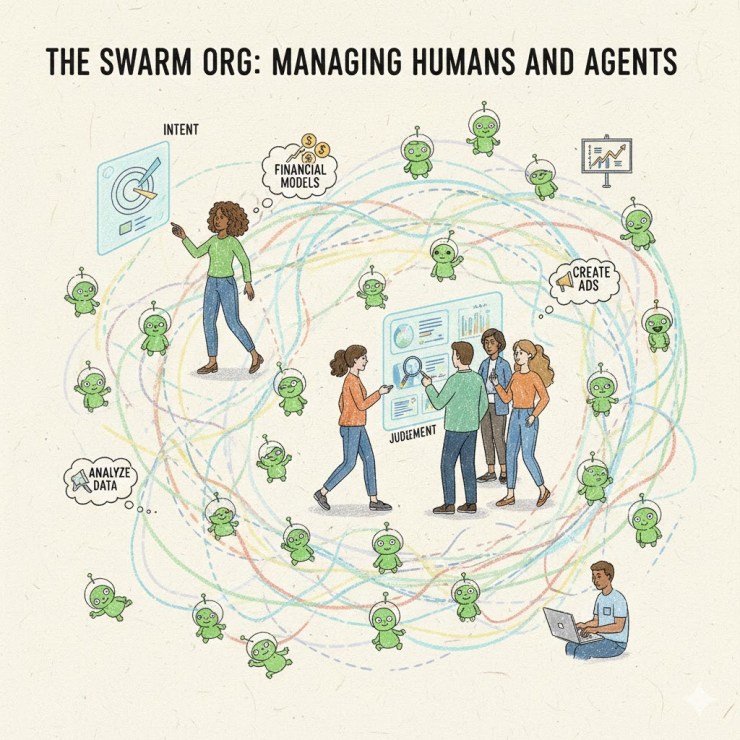
Our teams are becoming a mix of humans and agents, working in swarms.
To get the most out of AI, knowing what you want, being clear on your intent and communicating it clearly is crucial. Which truthfully is not that different from successfully managing human teams, it’s just that many managers suck at this. The difference is that now we’re managing humans and agents in parallel.
Most commentators focus on the fact that agents work 24 hours, are endlessly patient, don’t need a pay raise or a promotion. I’m more interested in what this shift will do to the way we work and lead, and to organisational design.
Great judgement and the ability to assess output matters more than execution. The ability to interpret metrics matters more than doing the analysis.
Job titles matter less. Hierarchy matters less. It will be replaced by swarms of people and agents working cross-functionally regardless of where they sit in the org, rather than people working up and down the reporting chain within a function. Process matters less. Endless email and Slack threads coordinating tasks will be greatly reduced.
Team size as a leverage is turned upside down – smaller teams that use agents will beat bigger teams that don’t. What matters is how good are your people at managing agents that work for them, and what skills they need so you can keep the human:agent ratio small. This is why the best AI native companies have higher revenues per employee, compared to traditional companies or the even the best Saas companies. The best AI-native companies, ones that have truly mastered agent orchestration like Cursor ($3M/employee), are achieving 6x the efficiency of the best SaaS companies like Salesforce and Notion ($500K/employee). (A counter-example: Google’s already at $2M per employee without really trying – and they own the infrastructure that powers AI. I’m long on Google.)
Deeply understanding what users and customers want and building great products matters. The best way to do that is to co-create with them – helping customers figure out how to orchestrate agents for their user cases. Domain expertise matters, especially in areas like healthcare that are heavily regulated. Things that seemed impossible suddenly become possible, at much faster speeds.
So what does this mean for you, me, all of us?
Personally, I welcome that change. I’ve always struggled with hierarchy, process, set ways of doing things. I’ve always loved working across functions, with people who didn’t report to me. I’ve always loved working with small teams, while my peers built large empires to get promoted. (At some point Google had a requirement for VP scope that it would involve managing 1000 people – how antiquated that seems now…) My natural management style is hands-off – I describe the outcome I want and ask my team to run towards it, with little direction. I’ve always been frustrated by slow speed – that’s one reason I’m leaving healthcare and going back to tech. And I’ve always tried to do things that seemed impossible. I’ve often failed because the system was just too hard to beat – including with my healthcare startup. Maybe I’ll fail less in an AI + human world 🙂
If you’re scared, you are not alone – I’m scared too. Change at this pace is bewildering. These changes to hierarchy, process, team size will be painful for millions of middle managers and individual contributors whose jobs were built around those structures. This transition will be rough. Not everyone will win. That’s a hard truth we can’t ignore, and we haven’t even begun to figure out how to ensure that people are not left behind, and that as many people as possible benefit from the way AI will change the world of work.
But worrying about what we can’t control won’t help. What we can control is whether we start learning now or get left behind. My coding friends have been using Codex and Claude Code for ages, and I’ve been jealous. Claude Cowork was a breakthrough for me – suddenly I could deploy Claude’s prowess that was built for coding to my everyday tasks like writing a company overview for investors, making a financial model, making sure I don’t miss emails from people I care about now that my inbox is full of AI slop, posting stuff on Facebook marketplace, monitoring job websites for interesting things that pop up. You can also try Dreamer.com, an agent framework for consumers just launched by my friends David Singleton and Hugo Barra (yes, this is a blatant plug for them).
If you’re a parent, help your kids become discerning users of AI, help them to build judgement. Kids are much better at saying what they want, so maybe they can teach you a thing or two about how to write a good prompt!
If you are a people leader, your most important task right now is to help your team members through this transition. Nothing else matters. And that requires that you change your personal working style – you have to get hands on with AI in your work yourself, not wait for your team to figure it out. Experiment. Give AI tasks you thought were impossible for AI to do, not just toy tasks. If they fail, wait for the next model release and try again, don’t assume AI will never be able to do this.
The skills you personally build and that your teams and your kids build in the next few months will pay off for years to come.











 Obi Felten