Resilience in the Age of AI | AI’s impact on young people

The OpenAI Foundation split off from OpenAI last year, and is now the biggest private foundation in the world. One of the Foundation’s focus areas is AI Resilience, led by OpenAI co-founder Wojciech Zaremba. Wojciech draws an analogy between AI and another general purpose technology: Fire.

Like fire, AI has many benefits but can also be dangerous. Over time, societies built resilience via many different layers, including fire-resistant materials, hydrant networks, professional fire departments, and building codes. We need a similar resilience ecosystem for AI, and Wojciech is funding it with OpenAI’s sky high share price. The foundation owns 26% of OpenAI stock, which makes them the biggest private foundation in the world, ahead of Novo Nordisk, Gates and Wellcome. They and sold an undisclosed sum in OpenAI’s fundraising round earlier this year to fund their first investments.

In March and April, I got the opportunity to work with Wojciech to help shape their funding strategy for AI’s impact on young people. The initial focus is to fund independent research to better understand where AI can support development, the risks it may introduce, and the contexts that shape those effects. AI has the potential to positively or negatively impact human connection, learning, and development – and without good measurement we won’t be able to steer it responsibly.I’m excited for the first funding announcements, hopefully they will be public soon!

Here’s an excerpt from OpenAI Foundation’s official announcement today that describes the work:

AI’s impact on young people

Young people are often the earliest adopters of new technologies, using them to learn, create, communicate, and explore the world. AI is no exception. But as these tools become an increasing part of young people’s daily lives, it is critical that we develop a stronger evidence base to understand its impacts.

Families, schools, policymakers, and community organizations are all grappling with questions about how and when young people engage with AI—including its impact on human connection, learning, and development. Our initial focus will be on advancing independent research to help guide those decisions—to better understand where AI can support development, the risks it may introduce, and the contexts that shape those effects.

These insights should drive broad safety standards and design principles that guide how any AI product is developed, how schools choose to deploy them, and if and how families decide to incorporate these technologies into their lives.

Ethan Mollick: “People like AI when they use it themselves; they don’t like AI writ large”

Ethan Mollick, associate professor of management at Wharton, is one of my favourite thinkers on AI impact on society, including work and education. He recently did an interview with Tom Rachman, an AI Policy Writer at Google DeepMind. The questions they discussed really resonated with me.

How can companies get their employees to use artificial intelligence when human intelligence remains sharp enough to know that this risks replacing jobs?

How should education revise itself for the ever-revising technological world that students emerge into?

And how to understand the love/hate relationship so many people have with AI?


I think about these questions all the time – in discussion with my kids, friends and colleagues, when I give talks on AI.

I agree with Ethan when he says: “This is a leadership problem. The incentives have to be aligned properly. Currently, it’s, ‘I’m going to automate your jobs away’ or ‘I’m not going to share with you any of the gains the company gets.’ People are exquisitely tuned to rewards. So it’s about leaders articulating a vision of what the world looks like with AI for employees. ‘What should I expect to do? How are people rewarded for doing the right thing? If they automate 90 percent of my job, what happens to me?’ Without those answers, everything else is secondary.”

Nobody has the answers right now, but it’s our job to figure it out with our teams.

Another question is how we teach entry level workers expertise, which traditionally was taught by doing. If using AI well requires taste, how can you acquire that taste if your job is outsourced to AI?

Ethan talks about people needing to be t-shaped – broad and adaptable, and deep on one area. I am a t-shaped person (generalist with product depth) and I often felt I didn’t really fit in, because companies tend to organise functionally and prioritise subject matter expertise.

I also love being a ‘super IC’ with a small team, while my coworkers built empires. At some point to get promoted to VP at Google your role had to have hundreds of reports. I bet they don’t have that rule anymore 🙂

So personally I am excited that the old conventions of management are getting blown up. But I realise that many people find it scary because the existing system suited them.

Read the full interview here: https://www.aipolicyperspectives.com/p/q-and-a-with-ethan-mollick

And Ethans’s Substack here: https://www.oneusefulthing.org/

Image credits: AI Policy Perspectives

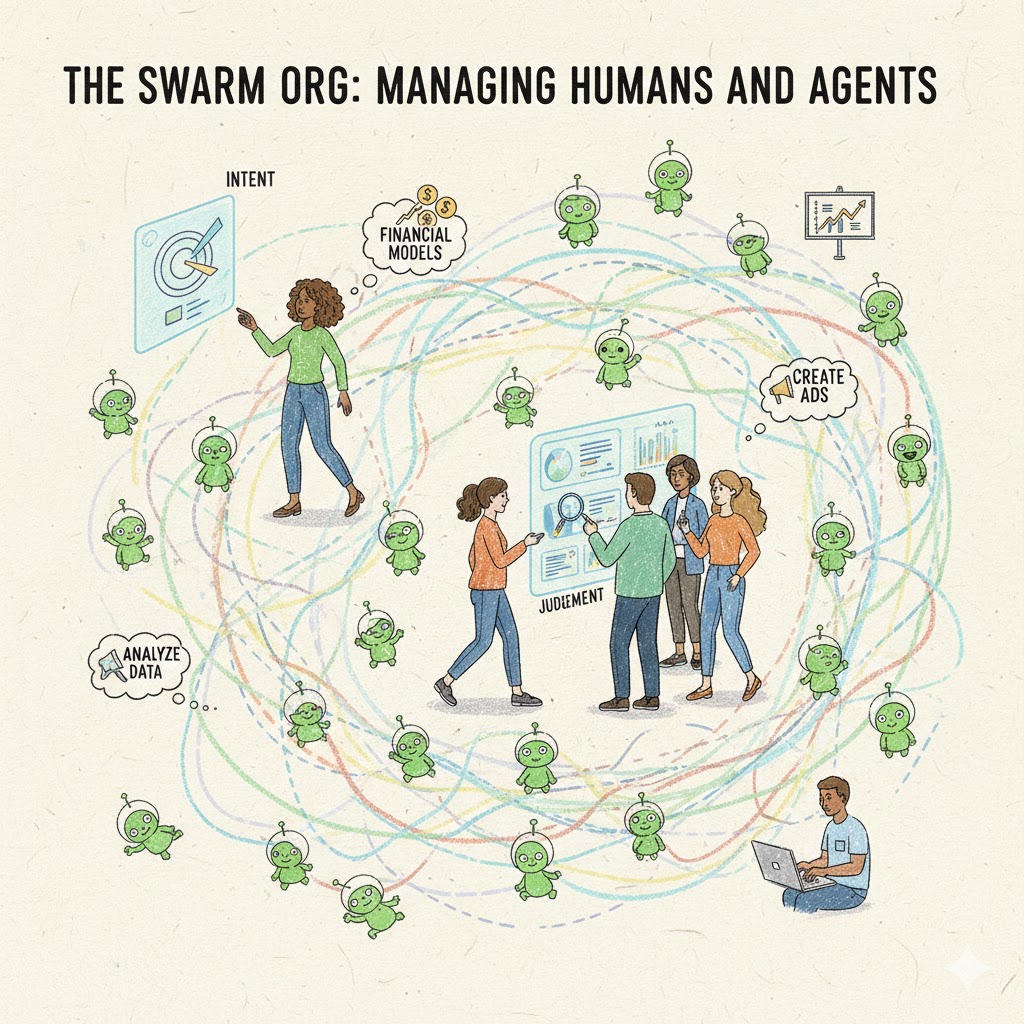
The Swarm Org: Managing Humans and Agents

AI is profoundly changing the way we work with each model release. My tasks that Claude struggled with a few months ago are now done in Cowork in a few minutes. The new Claude model 4.6 is insanely good. Bigger context window, ability find and retrieve info in this context window, ability to have several agents collaborate massively changes the game again. It speed things up, and needs less human intervention.

Watch Nate B. Jones’ take on Opus 4.6 below, which inspired me to write this post. He is mostly talking about coding in the first part, then how this flows through to non-technical users like me who can suddenly do tasks that used to take us days in hours or minutes, and how it will change orgs.

Our teams are becoming a mix of humans and agents, working in swarms.

To get the most out of AI, knowing what you want, being clear on your intent and communicating it clearly is crucial. Which truthfully is not that different from successfully managing human teams, it’s just that many managers suck at this. The difference is that now we’re managing humans and agents in parallel.

Most commentators focus on the fact that agents work 24 hours, are endlessly patient, don’t need a pay raise or a promotion. I’m more interested in what this shift will do to the way we work and lead, and to organisational design.

Great judgement and the ability to assess output matters more than execution. The ability to interpret metrics matters more than doing the analysis.

Job titles matter less. Hierarchy matters less. It will be replaced by swarms of people and agents working cross-functionally regardless of where they sit in the org, rather than people working up and down the reporting chain within a function. Process matters less. Endless email and Slack threads coordinating tasks will be greatly reduced.

Team size as a leverage is turned upside down – smaller teams that use agents will beat bigger teams that don’t. What matters is how good are your people at managing agents that work for them, and what skills they need so you can keep the human:agent ratio small. This is why the best AI native companies have higher revenues per employee, compared to traditional companies or the even the best Saas companies. The best AI-native companies, ones that have truly mastered agent orchestration like Cursor ($3M/employee), are achieving 6x the efficiency of the best SaaS companies like Salesforce and Notion ($500K/employee). (A counter-example: Google’s already at $2M per employee without really trying – and they own the infrastructure that powers AI. I’m long on Google.)

Deeply understanding what users and customers want and building great products matters. The best way to do that is to co-create with them – helping customers figure out how to orchestrate agents for their user cases. Domain expertise matters, especially in areas like healthcare that are heavily regulated. Things that seemed impossible suddenly become possible, at much faster speeds.

So what does this mean for you, me, all of us?

Personally, I welcome that change. I’ve always struggled with hierarchy, process, set ways of doing things. I’ve always loved working across functions, with people who didn’t report to me. I’ve always loved working with small teams, while my peers built large empires to get promoted. (At some point Google had a requirement for VP scope that it would involve managing 1000 people – how antiquated that seems now…) My natural management style is hands-off – I describe the outcome I want and ask my team to run towards it, with little direction. I’ve always been frustrated by slow speed – that’s one reason I’m leaving healthcare and going back to tech. And I’ve always tried to do things that seemed impossible. I’ve often failed because the system was just too hard to beat – including with my healthcare startup. Maybe I’ll fail less in an AI + human world 🙂

If you’re scared, you are not alone – I’m scared too. Change at this pace is bewildering. These changes to hierarchy, process, team size will be painful for millions of middle managers and individual contributors whose jobs were built around those structures. This transition will be rough. Not everyone will win. That’s a hard truth we can’t ignore, and we haven’t even begun to figure out how to ensure that people are not left behind, and that as many people as possible benefit from the way AI will change the world of work.

But worrying about what we can’t control won’t help. What we can control is whether we start learning now or get left behind. My coding friends have been using Codex and Claude Code for ages, and I’ve been jealous. Claude Cowork was a breakthrough for me – suddenly I could deploy Claude’s prowess that was built for coding to my everyday tasks like writing a company overview for investors, making a financial model, making sure I don’t miss emails from people I care about now that my inbox is full of AI slop, posting stuff on Facebook marketplace, monitoring job websites for interesting things that pop up. You can also try Dreamer.com, an agent framework for consumers just launched by my friends David Singleton and Hugo Barra (yes, this is a blatant plug for them).

If you’re a parent, help your kids become discerning users of AI, help them to build judgement. Kids are much better at saying what they want, so maybe they can teach you a thing or two about how to write a good prompt!

If you are a people leader, your most important task right now is to help your team members through this transition. Nothing else matters. And that requires that you change your personal working style – you have to get hands on with AI in your work yourself, not wait for your team to figure it out. Experiment. Give AI tasks you thought were impossible for AI to do, not just toy tasks. If they fail, wait for the next model release and try again, don’t assume AI will never be able to do this.

The skills you personally build and that your teams and your kids build in the next few months will pay off for years to come.