
By Darius Rafieyan
This article was published on Nov 2,2023
Copyright Business Insider 2023
Read the original on BusinessInsider.com (subscription required)
- Leaders In Tech is a four-day, invite-only retreat for tech founders and CEOs held in Northern California.
- The retreat is the brainchild of author and executive coach Carole Robin, and is based on the Interpersonal Dynamics course she taught at Stanford Business School.
- The retreat, which costs about $10,000, is meant to help participants open up and cope with the loneliness of helming a prominent tech company.
Photo: Justin Kaneps
On a recent weekend, at a seaside resort outside San Francisco that once served as a pleasure palace for a turn-of-the-century radio mogul and later became the home of a sinister, new age cult, twelve perfect strangers sat in a circle overlooking Tomales Bay.
As the sun glinted on the water and a breeze off the wetlands shook needles loose from the pines overhead, Joe—founder and CEO of a fintech startup most recently valued at $45 million, who opted not to use his real name for this story because of the personal nature of what he was speaking about—recounted the day last year that his father died. He had been devastated, but didn’t feel like he could take a day off. His company was in the middle of raising a funding round and he just couldn’t let his team down. There was no time for grief in his busy schedule.
Joe knew next to nothing about the people he was confiding in, not how many exits they’d had, nor who their investors were. He didn’t even know their last names. But he knew they were all founders and that they understood, and so he did something he hadn’t allowed himself to do in a very long time: he cried.
“Once the words came out, I was emotionally exhausted, but I was also relieved,” Joe said.
This was day one of Leaders In Tech, a four-day, invite-only retreat for startup founders like Joe, designed to help them open up, process trauma, and learn to cope with the loneliness that comes with helming a prominent tech company.
The program is the brainchild of Carole Robin, an author and executive coach who for more than 20 years taught the Interpersonal Dynamics course at Stanford Business School.
She says that founders are expected to be relentless optimists, and impervious to doubt. Whether it’s their investors, their employees, or even their spouses, the pressure is always to tell a story that goes up and to the right.
“They don’t have anybody they can be real with,” Robin told Insider, “so they’re always having to spin their image, and spin what they say, and spin how they’re seen, which adds to the loneliness and the sense of isolation and also frankly, mental illness.”
A mental health crisis for founders
The data on founder mental health is spotty (most don’t like to advertise their struggles) but a 2015 survey of entrepreneurs from UC Berkeley found that 72% reported mental health concerns (for comparison only about 20% of the general population suffers from mental illness). Entrepreneurs in the survey were significantly more likely to report suffering from depression, bipolar disorder, anxiety, and substance abuse disorders.
These challenges have always been a fixture of the founder’s life and something of an open secret in Silicon Valley, but they’ve only been exacerbated by the recent market turmoil.
Some founders deal with the pressure by microdosing ketamine, or doing 48-hour fasts, or riding double-decker bicycles through the desert at Burning Man. But for many, even admitting that they’re struggling can feel impossible.
“You run into people at conferences and you talk about how everything’s great,” said Obi Felten, a former Google executive and founder of mental health startup Flourish Labs who attended a retreat last month. “You go through this whole bullshit, but there are very few people that you’re truly honest with,” she said.
With Leaders in Tech, Robin set out to create a space for founders to practice vulnerability, free of the need to always be crushing it.
It’s open to founders and CEOs who have raised at least a Series A but are pre-IPO, who for about $10,000 can spend four days in a charming bungalow on the grounds of the Lodge at Marconi resort in Marshall, California. Days are spent in intensive emotional labor with nights devoted to communal dinners and gatherings around the fireplace.
‘If you really knew me’
Participants meet in groups of 12, carefully selected to ensure no one is paired with a competitor or potential investor. Pitches, resume rundowns, or anything that smacks of networking is strictly forbidden.
“They’re being real. Nobody’s trying to sell anybody anything, nobody’s trying to raise money from anybody else,” Robin said.
They spend up to twelve hours a day in intensive “T groups” (Robin is quick to say the T stands for training, not therapy) where facilitators lead exercises designed to break down barriers and foster authentic connections.
For example there’s something she calls “If You Really Knew Me”—an exercise where founders talk about themselves for two minutes, beginning with the phrase “if you really knew me…”
Some responses from founders Robin remembers from past sessions:
“If you really knew me, you’d know that I feel like I have to put on a suit of armor every single morning when I leave the house.”
“If you really knew me, you would know that I’m, I’m worried about whether or not my marriage is going to survive my startup.”
“If you really knew me, you’d know that I will not sit here for four days and listen to everybody talk about how they’re crushing it.”
For Felten the retreat provided a welcome antidote to the transactional artificiality of networking events.
“In the first session we all exposed and disclosed stuff about ourselves that probably even some of our best friends or our partners might not know,” she said.
During her retreat Felten focused on anger, an emotion that as a female CEO she felt she was never allowed to express. On the second day in her T group, as she was opening up about her family’s struggle with addiction and mental illness, she exploded at one of the other participants.
“And I remember in the moment thinking, oh my god, I’m doing the thing that’s not okay to do, I’m getting angry,” she said. But rather than shut down her raw emotions, the other members of her group helped her process that anger and see that it was really just an expression of fear.
“Unpacking it in that safe environment was a massive breakthrough,” she said.
That evening after dinner, Felten went for a swim in the icy waters of Tomales Bay. She said the cold plunge felt like a much-needed reset after the hours of grueling emotional work. Floating out there in the Pacific, she was only two hours from Menlo Park but somehow a million miles from Silicon Valley.
Felten’s first day back at work after the retreat was rough. Her husband was out of town and the day started in a fight with her daughter that made her late for the Monday meeting. Feeling the anger bubbling up again and remembering what she learned in her T group, she decided to open the meeting with her colleagues by talking about what a hard time she was having. Others jumped in, commiserating about frustrating boyfriends and intractable children. Multiple employees later thanked her for creating the space to show weakness.
For Joe, the fintech founder, the plan had been to return to work Monday morning after the retreat. Instead just a few days after he broke down talking about his father, he did another thing that he hadn’t allowed himself to do in years: he took a day off for himself.
“Normally I would just dive back in,” Joe said, “but I remembered something someone in my T group said, they said, “you’re always taking care of everyone else, who’s taking care of you?”


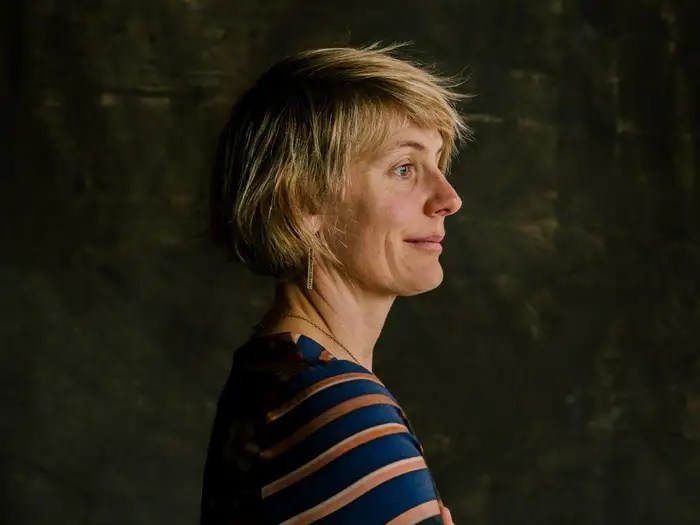
 Obi Felten