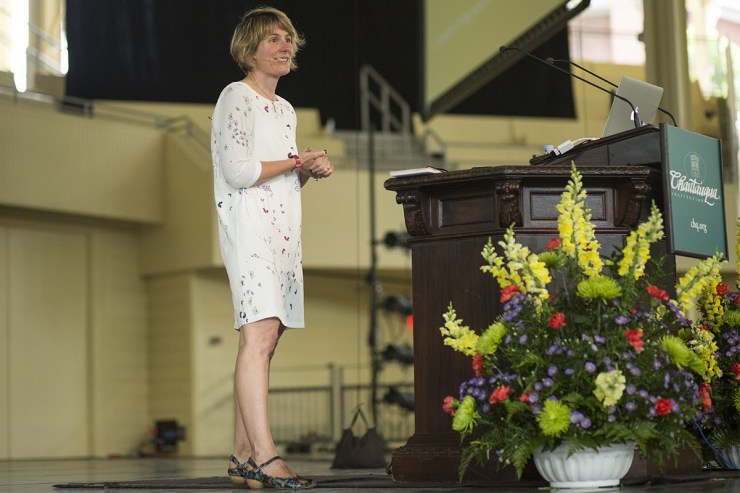

Chautauqua Institution summer season
26 June 2017
Chautauqua, New York
Keynote
“Living in modern times: The past, present and future of invention (and innovation)”
Obi delivered the opening lecture of the 2017 Chautauqua Institution summer season. Chautauqua Institution is a community on the shores of Chautauqua Lake in southwestern New York state that comes alive each summer with a unique mix of fine and performing arts, lectures, interfaith worship and programs, and recreational activities. Previous speakers include Franklin Delano Roosevelt, Hillary Clinton, Ruth Bader Ginsburg, Tarana Burke, Arthur Brooks.
Watch the full lecture
Article on this talk
Obi Felten discusses moonshots and the power of innovation to make sci-fi a reality
By Brian Contreras
Photos by Cam Buker
This article was published on 26 June 2017
Copyright The Chautauquan Daily
Read the original on Chqdaily.com
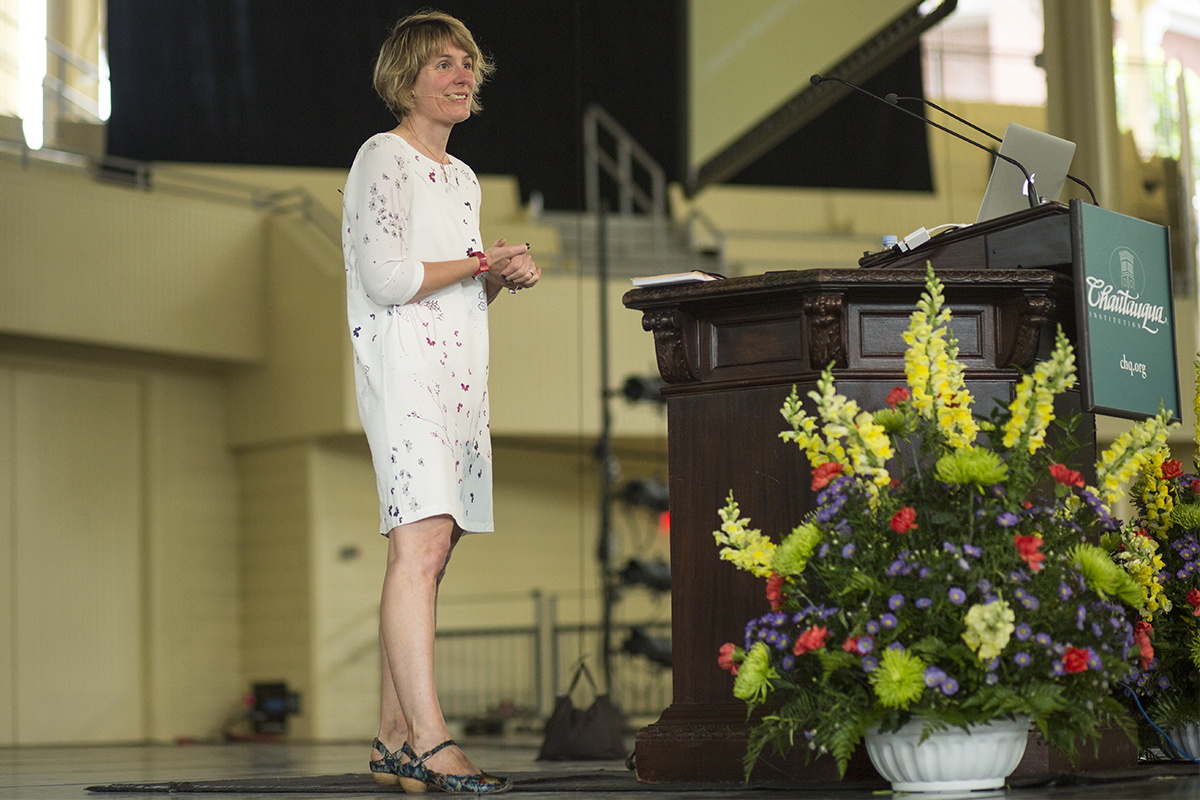
Xerox PARC scientist Alan Kay once said, “The best way to predict the future is to invent it.”
Obi Felten opened her Monday morning lecture with this quote, in turn opening the 2017 Chautauqua season as well as Week One and its theme of “Invention,” which asks, among other questions, what it might take for humanity’s next “giant leap.”
In her capacity as head of getting moonshots ready for contact with the real world at X (formerly Google X), Felten knows a thing or two about invention, not to mention the future. At X, she has worked with ideas that seem straight out of science fiction; they might seem more at home on the silver screen, but these inventions could one day be real, at least if Felten has her way.
After opening with Kay’s quote and enumerating a number of the cutting-edge inventions her X team has worked on, Felten launched full-steam into outlining what X does, and perhaps more urgently, what her lengthy job title actually consists of.
“We call ourselves the moonshot factory,” Felten said, “and we aim to solve large problems in the world with the help of technology.”
Though the work itself is hard, the moonshot team’s process is seductively simple. First, identify a problem (and not just any problem, but a big one, the sort that impacts “millions or even billions of people”). Then, propose a solution, no matter how outlandish, how seemingly impossible, it is. Finally — and this is where the difficult work of invention comes in — “turn (that) fiction into reality.”
Though making these moonshots real is never easy, Felten said it’s worth it. An optimist about the power of technology to make the world a better place, she cautioned against thinking of the current era as a uniquely disruptive one; as poet Alan Kirsch noted, all generations tend to think they live in periods of fundamental change.
That said, Felten made clear the modern age is by no means lacking in disruption, especially of the technological sort. She pointed to the internet in particular as having enabled an enormous paradigm shift in what is possible.
“We live in San Francisco, and my children think it’s completely normal to have breakfast with my parents, who live in Germany,” Felten said.
Felten acknowledged that the enormous potential of these emergent technologies has not been distributed equally. But through X, she and her team are working to change that.
For instance, she said, over half the world’s population lacks access to the internet. It was this global inequity that Felten and her team set out to solve with Loon, their balloon-based internet accessibility project.
Following a concise history of the balloon as a disruptive technology — from hot air balloonist Auguste Piccard to NASA and Bell Labs’ 1950s “communication satellites” — Felten outlined Loon’s modern quest to create airborne, data-transmitting balloons that could float through the sky and bring internet access to those on the ground below.
But the project was not without its failures.
“Our balloons were supposed to last 100 days,” Felten said. “The first balloons lasted five days.”
Ultimately, however, innovative responses to the durability question and other issues were successful, and the Loon project took flight (both literally and metaphorically) during a 2013 test in New Zealand. It was then that a rural sheep farmer, Charles, became the first human being to ever use Wi-Fi transmitted via balloon.
These days, Loon’s devices can last up to 190 days, and while they’re at it, provide LTE speeds to those who might otherwise have gone without internet. They even helped provide emergency communications capacities when destructive floods hit the Peruvian coast this past March.
But Loon is far from the only moonshot that Felten has worked on while at X. After all, as she puts it, humanity is currently in the midst of a “fourth industrial revolution.” Internet balloons are but one of many projects her team has in progress.
Perhaps the most publicized of these moonshots has been the self-driving car, a which has since graduated into its own company, the headlines-making Waymo.
The idea of a self-driving car is not without precedent. Leonardo da Vinci — the most iconic of inventors — designed one as far back as 1478. But with its movements preprogrammed and the only terrain it was suited for being a theater stage, da Vinci’s concept still had a long way to go before it achieved Jetson-esque viability. From General Motors’ automated highway dioramas at the 1939 World’s Fair, through the 1971 launch of an automated Mars rover, to scientists at the Bundeswehr Uni Munich finally creating the first truly independent vehicle in the 1980s; the path to self-driving cars has been a long and circuitous one.

CAM BUKER/STAFF PHOTOGRAPHER
But this narrative reached its climax in the mid-2000s, when the Defense Advanced Research Projects Agency launched a contest to see who could develop the best self-driving car. From 2004 to 2007, teams from Stanford and Carnegie Mellon Universities dueled back and forth to build the smartest, longest-running vehicle; it wasn’t until 2009 when members of both teams united under the Google self-driving car project that Felten’s moonshot began the trudge toward realization. All this time, though, the moonshot team stayed focused.
“The problem we’re trying to solve is safety,” Felten said. “Because 1.2 million people die on the road each year, and 94 percent of those accidents are caused by human error.”
The project’s work paid off in very real, human terms last year, when a blind man in Austin, Texas, took the world’s first truly autonomous ride in one of the team’s self-driving cars.
There is still a ways to go before their moonshot gets to its proverbial moon, Felten said, “but it’s exciting to see that we’re (turning) science fiction into reality.”
But with revolutionary projects like internet balloons or self-driving cars, Felten warned that it’s easy to get sucked into “the great myth of the lonely genius inventor.” Though people imagine the likes of Thomas Edison or Steve Jobs creating their legendary inventions in isolation, groups like X work hard to foster teamwork, communication and partnerships across any number of different industries and disciplines.
The myth of individualism isn’t the only concept that threatens to impede innovation, however; more than anything else (including funding), Felten sees a fear of failure as the single largest threat to inventing one’s way to a better future.
“To be audacious, you have to be humble,” Felten said. “And you have to expect that most of what you work on will not work.”
This is not abstract for Felten, either; her moonshot team takes pride in its failed projects. For instance, their abandoned Project Foghorn sought to turn ocean water into clean, efficient car fuel but was unable to overcome the steep competition with cheap oil. When it was ultimately shut down, all team members received bonuses for their decision to abandon the (at least temporarily) intractable concept.
As her lecture drew to a close, Felten returned to cultural fears about, rather than hopes for, new technologies. At first, she acknowledged the potential for new technology to widen, rather than bridge, gaps in socioeconomic class and quality of life; she also noted discomfort with the capacity for job automation to cause widespread unemployment.
But even if “we need to adapt” to keep pace with rapidly changing technological capacities, Felten ultimately sees this disruption as providing humanity with the opportunity to create for itself a more hospitable, equitable planet.
“We have a choice about which world we want to live in,” she said.
Felten presented essentially two versions of the future: one in which “the largest beneficiaries of invention are … the innovators, the shareholders, the investors,” or one where “innovation doesn’t just come from the hands of companies … but from anywhere.”
Either way, the choice between those two potential paths is in the hands of people, not their tools.
“Technology of course will not solve all our problems, and there is no doubt that it will create some new ones,” she said. “But it is up to us how we use technology to make a better future for ourselves and for generations to come.”



 Obi Felten