The Swarm Org: Managing Humans and Agents

AI is profoundly changing the way we work with each model release. My tasks that Claude struggled with a few months ago are now done in Cowork in a few minutes. The new Claude model 4.6 is insanely good. Bigger context window, ability find and retrieve info in this context window, ability to have several agents collaborate massively changes the game again. It speed things up, and needs less human intervention.

Watch Nate B. Jones’ take on Opus 4.6 below, which inspired me to write this post. He is mostly talking about coding in the first part, then how this flows through to non-technical users like me who can suddenly do tasks that used to take us days in hours or minutes, and how it will change orgs.

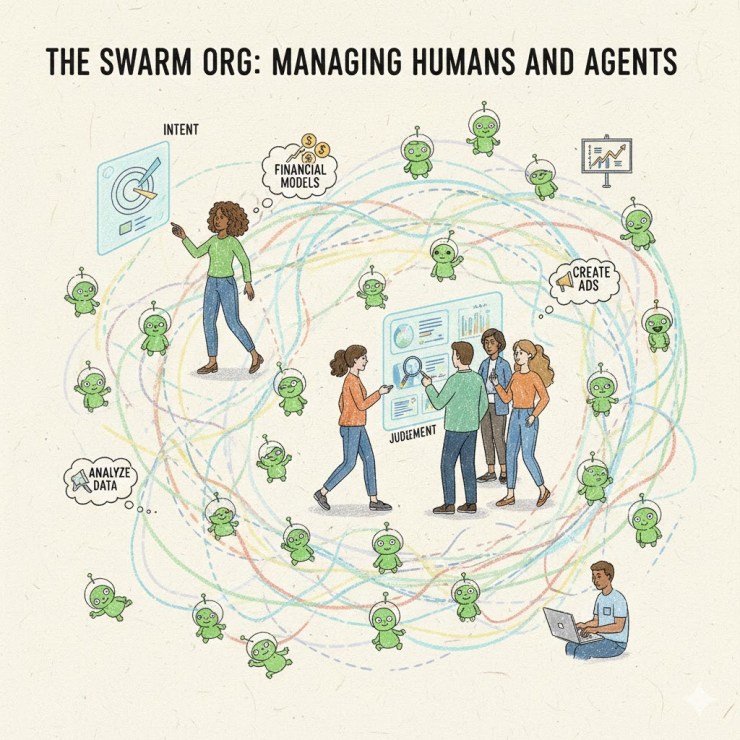
Our teams are becoming a mix of humans and agents, working in swarms.

To get the most out of AI, knowing what you want, being clear on your intent and communicating it clearly is crucial. Which truthfully is not that different from successfully managing human teams, it’s just that many managers suck at this. The difference is that now we’re managing humans and agents in parallel.

Most commentators focus on the fact that agents work 24 hours, are endlessly patient, don’t need a pay raise or a promotion. I’m more interested in what this shift will do to the way we work and lead, and to organisational design.

Great judgement and the ability to assess output matters more than execution. The ability to interpret metrics matters more than doing the analysis.

Job titles matter less. Hierarchy matters less. It will be replaced by swarms of people and agents working cross-functionally regardless of where they sit in the org, rather than people working up and down the reporting chain within a function. Process matters less. Endless email and Slack threads coordinating tasks will be greatly reduced.

Team size as a leverage is turned upside down – smaller teams that use agents will beat bigger teams that don’t. What matters is how good are your people at managing agents that work for them, and what skills they need so you can keep the human:agent ratio small. This is why the best AI native companies have higher revenues per employee, compared to traditional companies or the even the best Saas companies. The best AI-native companies, ones that have truly mastered agent orchestration like Cursor ($3M/employee), are achieving 6x the efficiency of the best SaaS companies like Salesforce and Notion ($500K/employee). (A counter-example: Google’s already at $2M per employee without really trying – and they own the infrastructure that powers AI. I’m long on Google.)

Deeply understanding what users and customers want and building great products matters. The best way to do that is to co-create with them – helping customers figure out how to orchestrate agents for their user cases. Domain expertise matters, especially in areas like healthcare that are heavily regulated. Things that seemed impossible suddenly become possible, at much faster speeds.

So what does this mean for you, me, all of us?

Personally, I welcome that change. I’ve always struggled with hierarchy, process, set ways of doing things. I’ve always loved working across functions, with people who didn’t report to me. I’ve always loved working with small teams, while my peers built large empires to get promoted. (At some point Google had a requirement for VP scope that it would involve managing 1000 people – how antiquated that seems now…) My natural management style is hands-off – I describe the outcome I want and ask my team to run towards it, with little direction. I’ve always been frustrated by slow speed – that’s one reason I’m leaving healthcare and going back to tech. And I’ve always tried to do things that seemed impossible. I’ve often failed because the system was just too hard to beat – including with my healthcare startup. Maybe I’ll fail less in an AI + human world šŸ™‚

If you’re scared, you are not alone – I’m scared too. Change at this pace is bewildering. These changes to hierarchy, process, team size will be painful for millions of middle managers and individual contributors whose jobs were built around those structures. This transition will be rough. Not everyone will win. That’s a hard truth we can’t ignore, and we haven’t even begun to figure out how to ensure that people are not left behind, and that as many people as possible benefit from the way AI will change the world of work.

But worrying about what we can’t control won’t help. What we can control is whether we start learning now or get left behind. My coding friends have been using Codex and Claude Code for ages, and I’ve been jealous. Claude Cowork was a breakthrough for me – suddenly I could deploy Claude’s prowess that was built for coding to my everyday tasks like writing a company overview for investors, making a financial model, making sure I don’t miss emails from people I care about now that my inbox is full of AI slop, posting stuff on Facebook marketplace, monitoring job websites for interesting things that pop up. You can also try Dreamer.com, an agent framework for consumers just launched by my friends David Singleton and Hugo Barra (yes, this is a blatant plug for them).

If you’re a parent, help your kids become discerning users of AI, help them to build judgement. Kids are much better at saying what they want, so maybe they can teach you a thing or two about how to write a good prompt!

If you are a people leader, your most important task right now is to help your team members through this transition. Nothing else matters. And that requires that you change your personal working style – you have to get hands on with AI in your work yourself, not wait for your team to figure it out. Experiment. Give AI tasks you thought were impossible for AI to do, not just toy tasks. If they fail, wait for the next model release and try again, don’t assume AI will never be able to do this.

The skills you personally build and that your teams and your kids build in the next few months will pay off for years to come.
Business Insider: Inside a secret haven for startup founders to overcome loneliness: ‘There’s very few people you can be honest with’

By Darius Rafieyan

This article was published on Nov 2,2023
Copyright Business Insider 2023
Read the original on BusinessInsider.com (subscription required)

  • Leaders In Tech is a four-day, invite-only retreat for tech founders and CEOs held in Northern California. 
  • The retreat is the brainchild of author and executive coach Carole Robin, and is based on the Interpersonal Dynamics course she taught at Stanford Business School. 
  • The retreat, which costs about $10,000, is meant to help participants open up and cope with the loneliness of helming a prominent tech company.
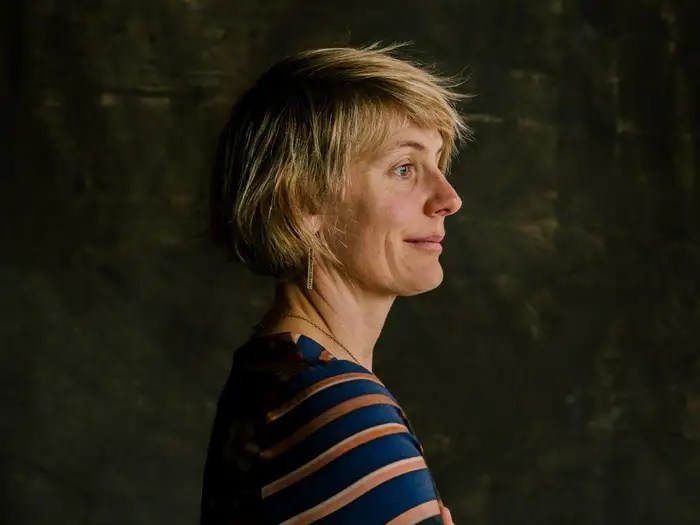
Obi Felten, founder of Flourish Labs
Startup founder Obi Felten said she struggled to find spaces where she could let her humanity show.
Photo: Justin Kaneps

On a recent weekend, at a seaside resort outside San Francisco that once served as a pleasure palace for a turn-of-the-century radio mogul and later became the home of a sinister, new age cult, twelve perfect strangers sat in a circle overlooking Tomales Bay.  

As the sun glinted on the water and a breeze off the wetlands shook needles loose from the pines overhead, Joe—founder and CEO of a fintech startup most recently valued at $45 million, who opted not to use his real name for this story because of the personal nature of what he was speaking about—recounted the day last year that his father died. He had been devastated, but didn’t feel like he could take a day off. His company was in the middle of raising a funding round and he just couldn’t let his team down. There was no time for grief in his busy schedule.

Joe knew next to nothing about the people he was confiding in, not how many exits they’d had, nor who their investors were. He didn’t even know their last names. But he knew they were all founders and that they understood, and so he did something he hadn’t allowed himself to do in a very long time: he cried. 

“Once the words came out, I was emotionally exhausted, but I was also relieved,” Joe said. 

This was day one of Leaders In Tech, a four-day, invite-only retreat for startup founders like Joe, designed to help them open up, process trauma, and learn to cope with the loneliness that comes with helming a prominent tech company.

The program is the brainchild of Carole Robin, an author and executive coach who for more than 20 years taught the Interpersonal Dynamics course at Stanford Business School. 

Carole Robin, co-founder of Leaders in Tech
Author and executive coach Carole Robin, speaking at a Leaders In Tech retreat. 

She says that founders are expected to be relentless optimists, and impervious to doubt. Whether it’s their investors, their employees, or even their spouses, the pressure is always to tell a story that goes up and to the right. 

“They don’t have anybody they can be real with,” Robin told Insider, “so they’re always having to spin their image, and spin what they say, and spin how they’re seen, which adds to the loneliness and the sense of isolation and also frankly, mental illness.”

A mental health crisis for founders

The data on founder mental health is spotty (most don’t like to advertise their struggles) but a 2015 survey of entrepreneurs from UC Berkeley found that 72% reported mental health concerns (for comparison only about 20% of the general population suffers from mental illness). Entrepreneurs in the survey were significantly more likely to report suffering from depression, bipolar disorder, anxiety, and substance abuse disorders.

These challenges have always been a fixture of the founder’s life and something of an open secret in Silicon Valley, but they’ve only been exacerbated by the recent market turmoil.

Some founders deal with the pressure by microdosing ketamine, or doing 48-hour fasts, or riding double-decker bicycles through the desert at Burning Man. But for many, even admitting that they’re struggling can feel impossible. 

“You run into people at conferences and you talk about how everything’s great,” said Obi Felten, a former Google executive and founder of mental health startup Flourish Labs who attended a retreat last month. “You go through this whole bullshit, but there are very few people that you’re truly honest with,” she said.

With Leaders in Tech, Robin set out to create a space for founders to practice vulnerability, free of the need to always be crushing it. 

Lodge at Marconi
The Leaders In Tech Retreat provides a world away from the relentless stress of Silicon Valley. 

It’s open to founders and CEOs who have raised at least a Series A but are pre-IPO, who for about $10,000 can spend four days in a charming bungalow on the grounds of the Lodge at Marconi resort in Marshall, California. Days are spent in intensive emotional labor with nights devoted to communal dinners and gatherings around the fireplace.

‘If you really knew me’

Participants meet in groups of 12, carefully selected to ensure no one is paired with a competitor or potential investor. Pitches, resume rundowns, or anything that smacks of networking is strictly forbidden.

“They’re being real. Nobody’s trying to sell anybody anything, nobody’s trying to raise money from anybody else,” Robin said. 

They spend up to twelve hours a day in intensive “T groups” (Robin is quick to say the T stands for training, not therapy) where facilitators lead exercises designed to break down barriers and foster authentic connections. 

For example there’s something she calls “If You Really Knew Me”—an exercise where founders talk about themselves for two minutes, beginning with the phrase “if you really knew me…” 

Some responses from founders Robin remembers from past sessions:

“If you really knew me, you’d know that I feel like I have to put on a suit of armor every single morning when I leave the house.”

“If you really knew me, you would know that I’m, I’m worried about whether or not my marriage is going to survive my startup.”

“If you really knew me, you’d know that I will not sit here for four days and listen to everybody talk about how they’re crushing it.” 

For Felten the retreat provided a welcome antidote to the transactional artificiality of networking events. 

“In the first session we all exposed and disclosed stuff about ourselves that probably even some of our best friends or our partners might not know,” she said. 

During her retreat Felten focused on anger, an emotion that as a female CEO she felt she was never allowed to express. On the second day in her T group, as she was opening up about her family’s struggle with addiction and mental illness, she exploded at one of the other participants. 

“And I remember in the moment thinking, oh my god, I’m doing the thing that’s not okay to do, I’m getting angry,” she said. But rather than shut down her raw emotions, the other members of her group helped her process that anger and see that it was really just an expression of fear. 

“Unpacking it in that safe environment was a massive breakthrough,” she said. 

That evening after dinner, Felten went for a swim in the icy waters of Tomales Bay. She said the cold plunge felt like a much-needed reset after the hours of grueling emotional work. Floating out there in the Pacific, she was only two hours from Menlo Park but somehow a million miles from Silicon Valley.

Felten’s first day back at work after the retreat was rough. Her husband was out of town and the day started in a fight with her daughter that made her late for the Monday meeting. Feeling the anger bubbling up again and remembering what she learned in her T group, she decided to open the meeting with her colleagues by talking about what a hard time she was having. Others jumped in, commiserating about frustrating boyfriends and intractable children. Multiple employees later thanked her for creating the space to show weakness.

For Joe, the fintech founder, the plan had been to return to work Monday morning after the retreat. Instead just a few days after he broke down talking about his father, he did another thing that he hadn’t allowed himself to do in years: he took a day off for himself.

“Normally I would just dive back in,” Joe said, “but I remembered something someone in my T group said, they said, “you’re always taking care of everyone else, who’s taking care of you?”

Freakonomics Radio: Steve Levitt’s ā€œPeople I mostly Admireā€

4 August 2023
Podcast
“Can a Moonshot Approach to Mental Health Work?”
Obi Felten used to launch projects for X, Google’s innovation lab, but she’s now tackling mental health. She explains why Steve’s dream job was soul-destroying for her, and how peer support could transform the therapeutic industry.

5 surprising things I have in common with economist Steve Levitt

Freakonomics co-author Steve Levitt and I had a great conversation on his “People I (Mostly) Admire” podcast, on everything from dream jobs and fantastic failures, to the power of mental health peer support and the fall of the Berlin Wall. These are topics close to Steve’s heart, so I also learnt quite a bit about him—including some surprising personal parallels!

Freakonomics co-author Steve Levitt recently invited me on his ā€˜People I (Mostly) Admire’ podcast. Our conversation ran the gamut: we discussed everything from dream jobs and fantastic failures, to the power of mental health peer support and the fall of the Berlin Wall. These are topics close to Steve’s heart, so I also learnt quite a bit about him—including some surprising personal parallels!

Here are 5  things that Steve and I have in common. The last one especially was a surprise!

  1. We are not afraid to fail because we prioritise learning.Ā Steve tries out more projects than the average academic. I’ve worked on many failed projects in my career. We talk about some of my favourites on the podcast, likeĀ Project LoonĀ andĀ Project FoghornĀ at X. We both continue to prioritise learning over a fear of failure in our roles today!
  2. We have close family members who struggled with serious mental illness, leading us to care deeply about mental health.Ā Having experienced the power of peer support, both giving it and receiving it, we are curiousĀ  about the science: what makes therapy and peer support effective, and how someone with much less training than a therapist can help others recover.
  3. We had the same business idea.Ā We both imagined matching people experiencing mental health struggles with peer supporters who have gone through the same. When Steve’s daughter Lily shared her experience recovering from an eating disorder on Instagram, she got countless DMs from other teens asking her for help. Steve never got around to setting up a peer support marketplace, and was delighted to discover that I set one up atĀ peers.net! šŸ™‚
  4. Our worldviews have been shaped by experiences with US and German culture, at different points in our lives.Ā Steve’s wife is German and he lives there now. I grew up in Berlin, went to the US as a high school exchange student as a teenager and almost missed the wall coming down, which we also talk about on the podcast.
  5. We both have imposterĀ  syndrome.Ā (Wait, what??? Steve Levitt has impostor syndrome!!) On the podcast, Steve wonders how many of his podcast listeners really feel like imposters, so he invites them to send a one line email toĀ PIMA@freakonomics.comĀ saying either ā€œimposterā€ or ā€œnot an imposterā€. I’m curious how many of you feel that they’re an imposter. If you’re brave enough to share openly, please let me know in the comments!Ā 

Thank you Steve, Morgan and the PIMA team for the enjoyable, interesting and sometimes challenging conversation.I was nervous at the beginning of the recording (imposter!!!!), sitting in a dark studio in San Francisco talking to Steve halfway across the world. By the end Steve and I could have chatted for two more hours. Mental health and peer support are complicated to unpack. The podcast format was perfect for it, especially since Steve had a personal connection. 

I’d love to do more podcasts on the topic of mental health and peer support, for example: How peer support works with other modalities/solutions to the mental health crisis, a deep dive on the science of peer support, hearing from others with lived experience of mental health challenges for whom peer support  has worked, and whether a chatbot could ever deliver proper peer support (which is  as much a philosophical as a technical question).

What conversations about peer support and mental health would you like to hear on a future podcast? Get in touch here and let me know!

You can listen and find the transcript on the Freakonomics websiteĀ here, or download the episode onĀ Apple Podcasts,Ā Google Podcasts,Ā Spotify,Ā Stitcher, or wherever you get your podcasts.Ā 

I’d love to do more podcasts on the topic of mental health and peer support, for example: How peer support works with other modalities/solutions to the mental health crisis, a deep dive on the science of peer support, hearing from others with lived experience of mental health challenges for whom peer supportĀ has worked, and whether a chatbot could ever deliver proper peer support (which isĀ as much a philosophical as a technical question).